Chris

Reuniting the engine and gearbox

 Rolling Chassis, Transmission  Comments Off on Reuniting the engine and gearbox
Jul 082013
 

My aim is to spend a long weekend in August (with the wishful thinking that it’ll be sunny!) to transform it from a bodyshell into a rolling chassis; installing the fuel system, rear suspension, engine/gearbox & ancillaries, front suspension and steering all in one hit. So I’ve got my work cut out to get everything ready in time.

The bonnet and front sub-frame need to be removed in order to fit the tiny radiator support brackets so I’m also going to remove the picture frame at the same time. It should then be possible to roll the engine and gearbox unit into place through the gap and avoid the hassles of installing the engine either from above or below.

The gap between the lobes at the lower front edge of the engine frames is only 22cm. However, if the water pump is removed, the engine is slightly narrower than this just below the height of the inlet manifold. The engine has been rebuilt by VSE with a new clutch fitted so I just had to attach the gearbox and bellhousing. However the reuniting of the transmission unit would feel like a major milestone had been reached!

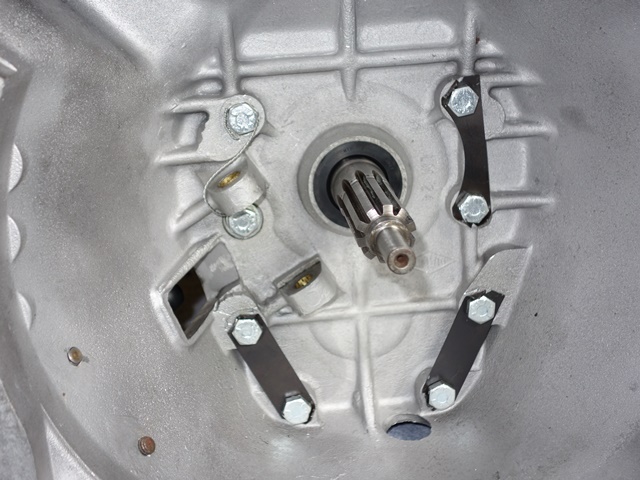
The bellhousing had already been ultrasonically cleaned and just needed the rear oil seal inserted before being bolted to the gearbox. Three lock tabs are used to prevent six of the bolts from working loose. The remaining two bolts, next to the clutch fork, use safety wire instead.

I’d never needed to use locking wire on previous vehicles so needed to purchase a pair of safety wire pliers. Eventually I managed to obtain an old pair on eBay and some 0.81mm stainless wire.

The pliers were definitely a good investment, less so was the wire that I purchased. It snapped as soon as a few twists were applied. I hadn’t purchased annealed wire – dooh! After purchasing the correct type, it was a lot more successful! The main point is to make sure the wire passing round the outside of the bolt head puts tension on the bolt in a clockwise direction.

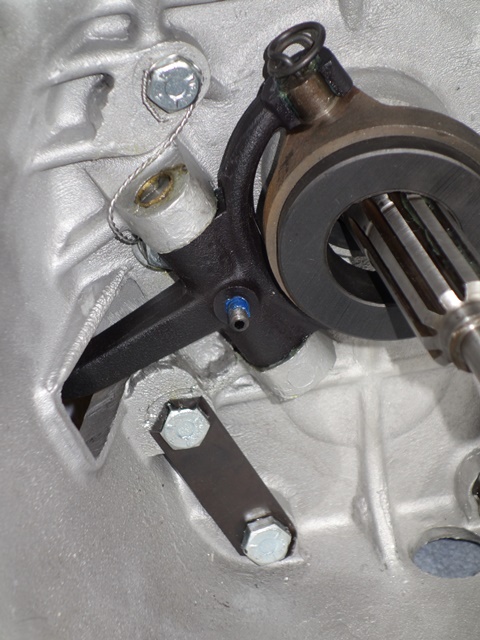
The fitting of the clutch release bearing and operating fork is all very straight forward. The fork can be inserted with the bearing attached which makes fitting the securing spring clips much easier. The clips are held in place by the curved end sitting in a slight dimple in the fork arm.

The push-fit spring clips secure the clutch release bearing to the operating fork. The curved spring end sits in a dimple in the fork

The pivot pin was lightly greased and aligned with the grub screw hole in the fork before inserting

A little Loctite was used on the grub screw which locks the pivot pin in position. A lock nut is then fitted on the grub screw.

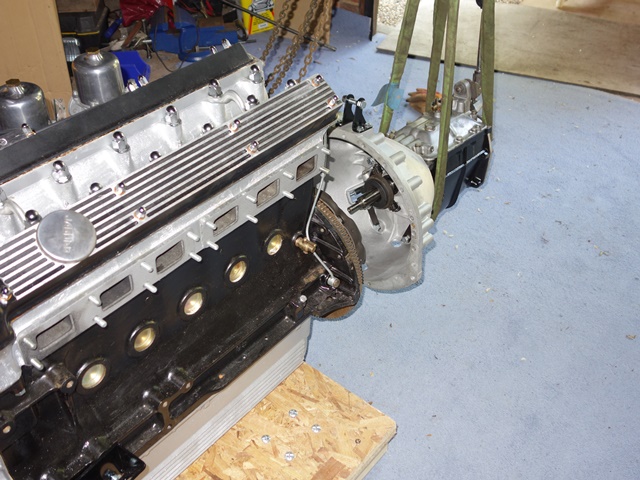
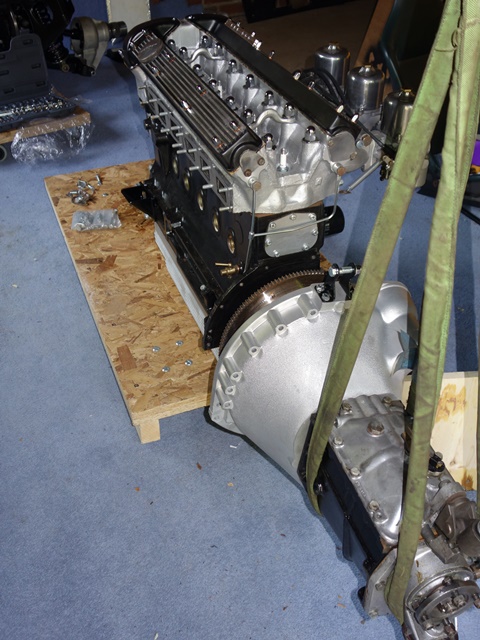
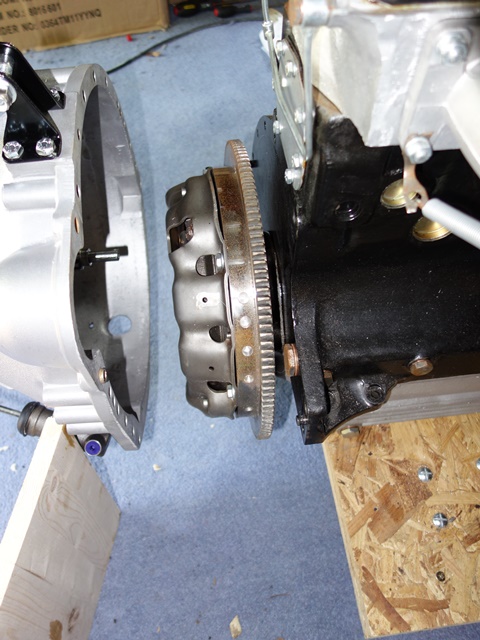
The engine was already sitting on the DIY trolley which will be used to roll it into position once the front frames are removed. Hoisting the gearbox to the same level meant it was simply a matter of rotating it to align the drive splines. Once the splines were engaged the gearbox could be rotated back again to align the bolt holes.

Supporting the gearbox with the engine hoist made the job much easier

It was also very helpful to have the engine mobile to align the two units

The weight of the gearbox was used to help push the gearbox onto the clutch splines

The two bellhousing support brackets needed to be installed before the full weight of the gearbox could be released. Finally the flywheel cover plate was bolted on to finish the job.

I did make the mistake of fitting the clutch slave cylinder when fitting the bellhousing to the gearbox but had to remove it to fit the lower bolt for the support bracket. I’ll make the final adjustments of the clutch just before the engine is installed.

One thing I’m not sure about at this stage is the orientation of the four vertical bolts for the support brackets. One of the bolts is longer than the others and so I guess must be used to secure a bracket of some description. Another question for the E-type forum ….

Fitment of the bellhousing support bracket is needed before it can take the full weight of the gearbox

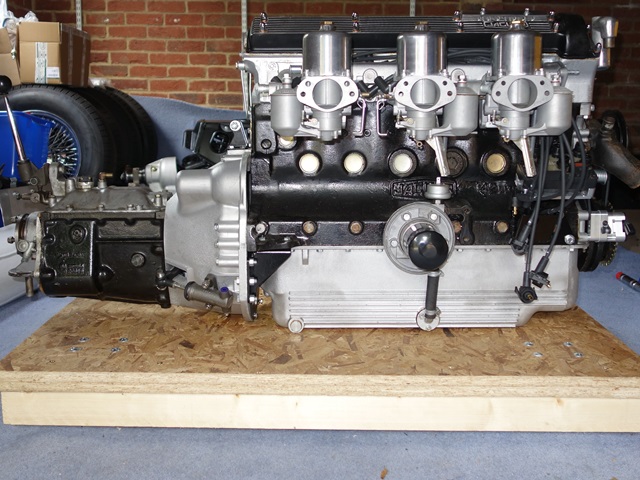
A major milestone reached - a completed transmission unit ready to fit. I hope it starts!!

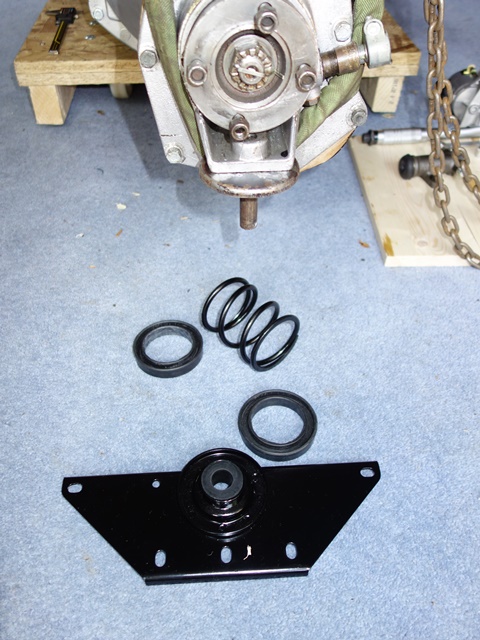
The rear of the gearbox has a sprung fitting to absorb vertical movement

The gearbox is supported at the rear by a large spring between a mounting bracket and the gearbox. The spring damps the movement of the gearbox but allows for a degree of vertical travel. The spring ends sit in rubber mouldings. The mounting bracket also contains a rubber bump stop to limit the gearbox travel.

Handbrake caliper rebuild

 Brakes, Rolling Chassis  Comments Off on Handbrake caliper rebuild
Jul 032013
 

Now the handbrake calipers have had been painted, all that remained was to rebuild them …. for the second time!

The service manual suggests the two rear calipers and handbrake mechanisms should be removed as single units. However this needs the half-shaft inner joints to be broken and the front springs/shock absorbers to be removed, which seemed unnecessary.

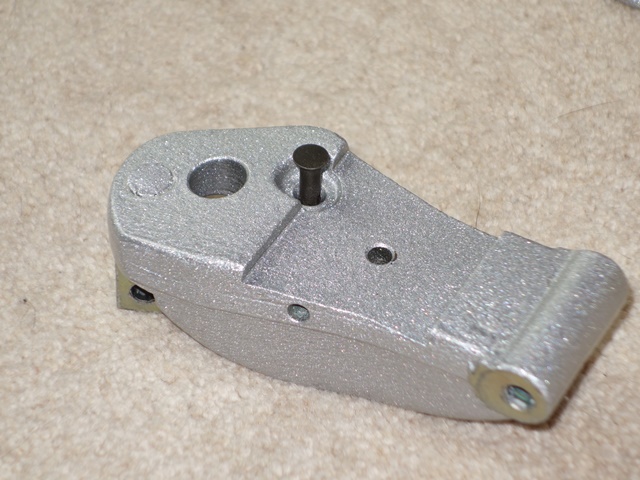
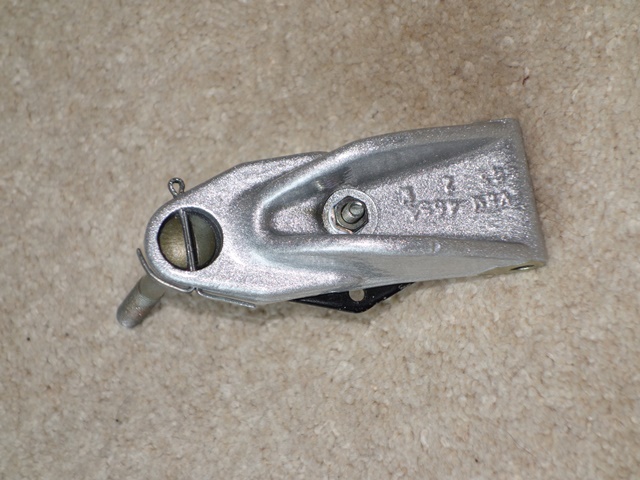
The components for the handbrake calipers and self-adjusting mechanism ready to be re-built

I found it much simpler to detach the handbrake mechanism from the rear calipers in situ and then remove them separately. So they won’t be re-united with the rear brake calipers until the refitting of the brakes into the IRS unit.

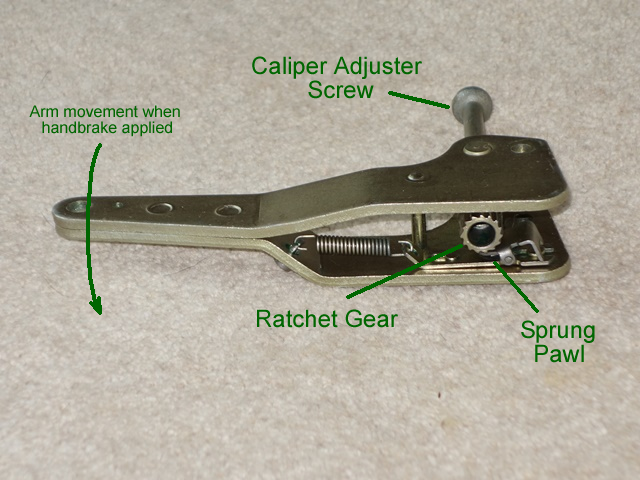
The handbrake system is self-adjusting using ratchet mechanisms to automatically compensate for the pad wear. The distance between the pad faces is determined by how far the caliper adjusting screw has been screwed into the ratchet gear.

When the handbrake is applied, the operating arm pivots on the pin attaching it to outer caliper arm. This effectively draws the caliper adjusting screw and attached inner caliper arm towards the outer caliper arm, resulting in a clamping force.

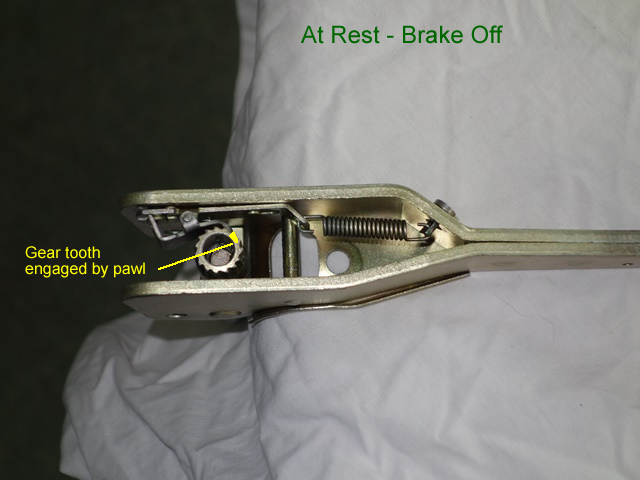
The pivoting action also allows the ratchet gear to move relative to the sprung pawl and the extent of movement is determined by the amount of pad wear.

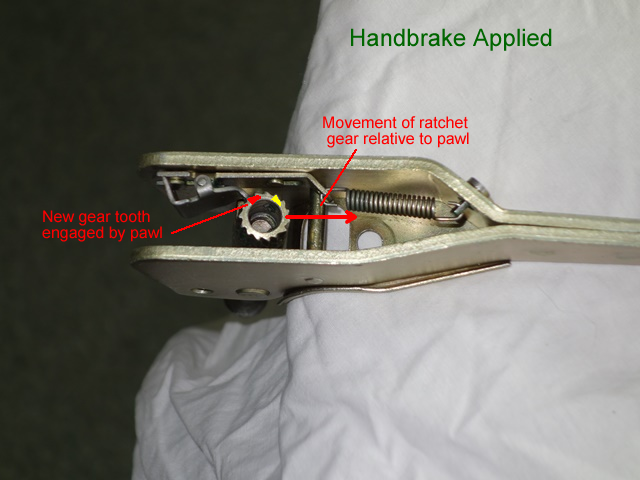
As the wear increases, the movement becomes sufficient such that the pawl slides along the shallow slope of the ratchet gear tooth and its spring forces it to drop onto the next tooth.

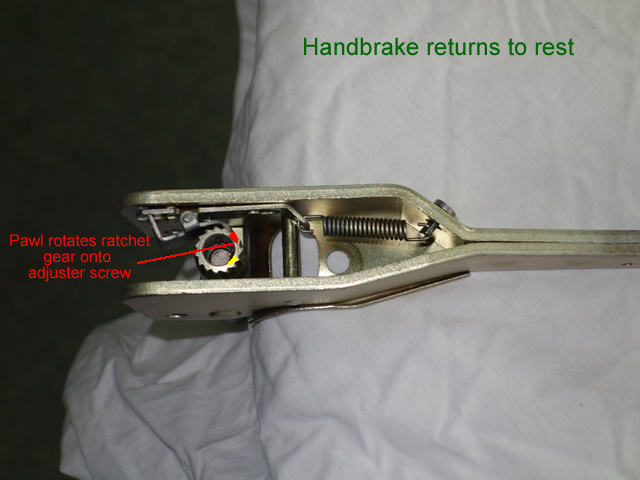
The ratchet gear moves back relative to the pawl when the handbrake is released. However the pawl now engages with the steeper slope of the tooth resulting in a turning force on the ratchet gear.

This torque rotates the ratchet gear further onto the adjuster screw and therefore reduces the distance between the two pads. The photos above attempt to show the ratcheting process, although in reality the ratchet gear will only be tightened one tooth at a time.

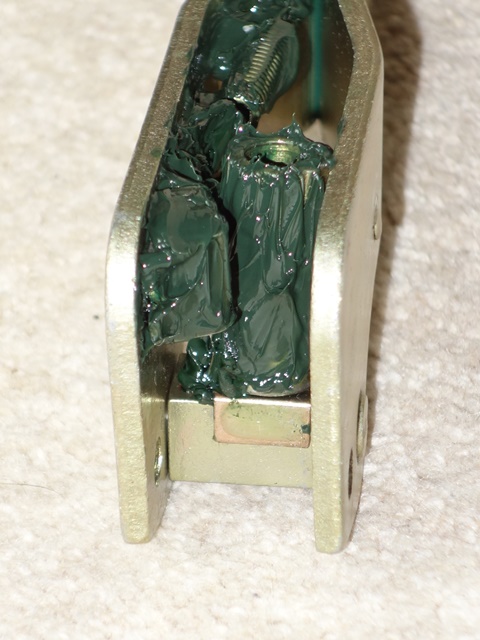
All the moving parts a given a generous covering of Lucas green brake grease before the cover plates were addedI’m not sure if there is a correct or recommended order for rebuilding the handbrake mechanism. I started with the internal parts of the operating arm; the pawl slots onto protrusions on the arm which guide and limit its travel. A tensioning spring attaches to the pawl and the other end to an anchor pin pushed through the operating arm.

The ratchet gear can then be installed which has a friction clip attached to its base. The clip provides sufficient resistance to stop the gear rotating when the pawl is gliding over the shallow tooth face. Once these were in place all the moving components were covered in high temperature brake grease.

The anchor pin for the return spring needs to be inserted into the outer caliper arm before the pads are fittedThe operating arm could then be attached to the outer caliper arm. I found it easier to fit the operating arm return spring first which is attached at one end to an anchor pin pushed through the caliper arm and the other to a shaft in the operating arm.

Note: the spring passes through a protective cover so this needs to be positioned before the spring is hooked over the operating arm shaft.

The pivot pin between the caliper arm and operating lever was then inserted and fixed with a split pin. A slotted screw and nut then clamp the two protective covers to the operating arm.

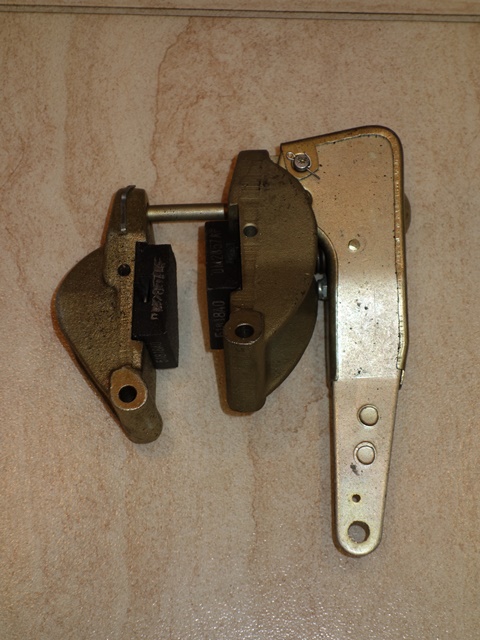
Finally the inner caliper arm was attached to the caliper adjuster screw with another split pin and screwed into the ratchet gear to complete the rebuild.

The caliper adjuster screw is fixed to the inner handbrake caliper with a split pin

The completed handbrake mechanisms awaiting fitting

Brake caliper rebuild

 Brakes, Rolling Chassis  Comments Off on Brake caliper rebuild
Jun 242013
 

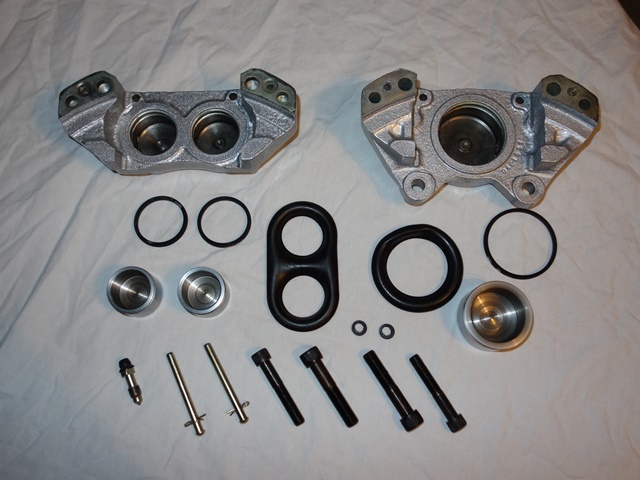
The components for the front calipers - including the small circular seals between the two halvesCaliper rebuild kits are readily available from many of the usual suppliers and contain the square sectioned seals which sit in recesses in the caliper piston bores and the outer dust shields.

The dust shields are similar to a expandable bellow with the ends sitting in a recesses in the piston bore and piston. This enables the rubber shield to stop ingress of foreign particles for the full travel of the pistons.

The kits however do not contain the small square sectioned ‘O’ rings that seal the two halves of the caliper.

I think the reason being that the manufacturer provides the following warning:

Girling “split” calipers should not be separated for any reason. They were not designed for separation and reassembly and proper torque specifications are not known, other than the inner and outer bolts are torqued differently.

It seems odd for the manufacturer to give the reason that the torque specifications are not known for their own product! I can understand their wish in avoiding customers trying to split the calipers in case they are not sealed correctly and the likely consequences. Again, being of a cynical nature, I suspect this has as much to do with fear of litigation.

However, when I contacted a caliper reconditioning firm, they suggested that as long as new seals are used and the bolts are sufficiently torqued there shouldn’t be a problem. Leaks were more likely to occur elsewhere. Although I will keep an eye on the calipers once in service … just in case.

Their recommendation was to torque the 7/16″ diameter bolts to 70 lb-ft and the 3/8″ diameter bolts to 40 lb-ft. Also to work from the outside in and alternating sides each time, ie torque the outer bolt on one side then the outer bolt on the other, followed by the inner bolt next to the first outer bolt and finally the remaining inner bolt.

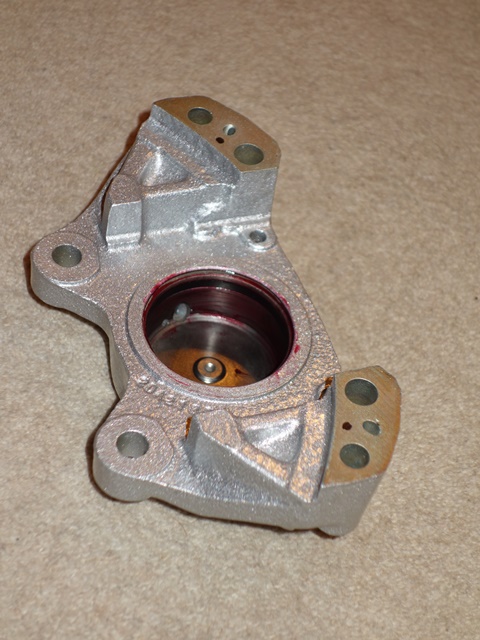
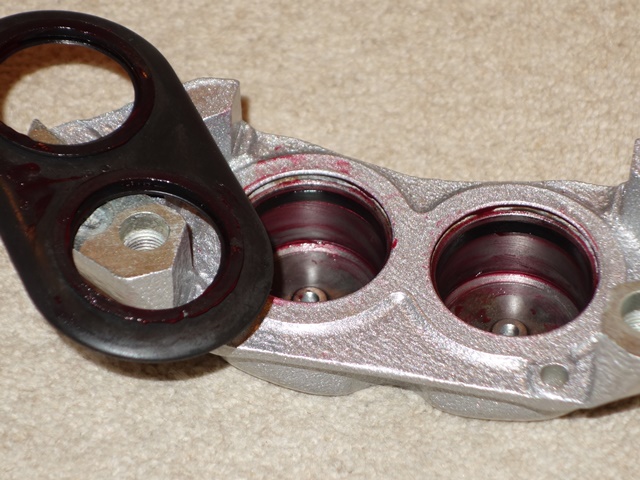
The front calipers have internal passageways to enable fluid to pass between the two halvesThe photo to the left shows the passageways for the brake fluid from the face where the two caliper halves join (the tip of the screwdriver is just about visible at the top of the upper piston bore). A corresponding passageway exists from the face of the other caliper joint and a small channel links the two piston bores. Thus providing the free flow of fluid between all the pistons in both halves of the caliper.

The rebuild is very straight forward. The bores and seal recesses were given a coating of Castrol Red Rubber Brake grease before the bore seal and outer dust rubber shield were fitted.

Grease was also applied to the cylinders before pressing home. The main point is to ensure the pistons were pushed in squarely to avoid damaging the seals. The outer lip of the dust shield pops into place as the piston is inserted.

Piston bore greased and seal inserted Dusty shield inserted before fitting piston

The piston bore and seal recess were covered with Girling Red Rubber grease before the seal was inserted into the recess

The rubber dust shields are insered into their groove in the caliper before pressing in the piston

Two smaller pistons & combined dust shield Greased pistons before pressing home

The front is a 3-pot caliper so one half has two smaller pistons with a combined dust shield

The pistons are also given a generous covering of rubber grease to ease fitting

Finally the two small seals between the caliper halves were greased and inserted into their recesses and the caliper bolts tightened to the torque setting above.

A square section 'O' ring sits in a recess  and provides the necessary seal between the two halves of the front caliper

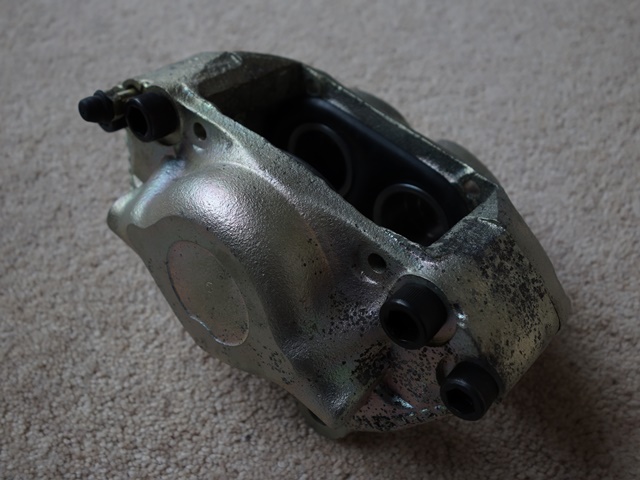
Completed front and rear main calipers

The main difference between the front and rear calipers is the rears employ an external pipe for the fluid to passed between the two halves and therefore there isn’t the need for the small seals.

Jun 182013
 

My initial plans were to upgrade the brakes to vented discs with calipers from either Zeus or Coopercraft. By all accounts deficiencies with the original S1 brakes were addressed for the S2 cars so I’ve had a change of heart and will be fitting the original braking system for now. I’ll see how it goes and decide on any changes once I’ve driven it for a while.

All the calipers were sporting many years worth of brake dust, dirt and grease and were to be stripped back, cleaned and rebuilt. The rears were worse but once liberated from the IRS unit they were fairly easy to dismantle.

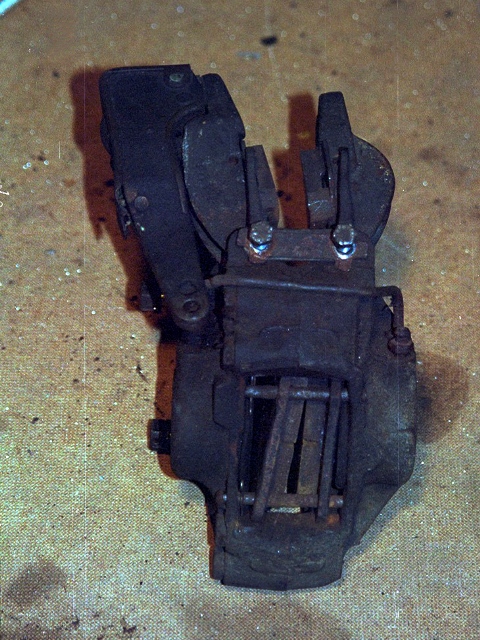
The rear calipers have the additional handbrake mechanisms attached

Rear caliper with external hydraulic pipe connecting the two halves

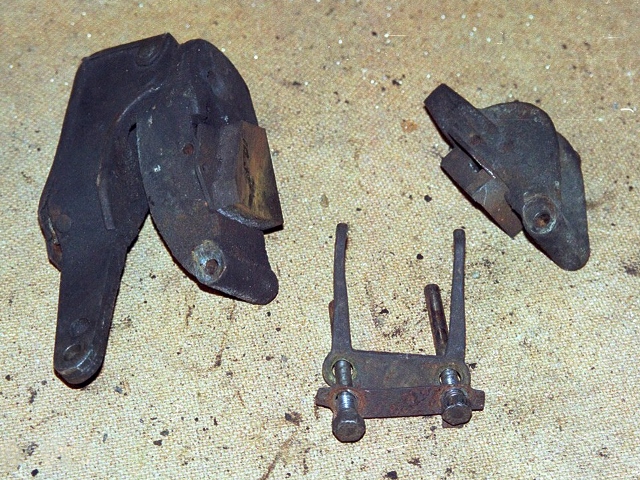
The handbrake ratchet mechanism and retraction fork

The handbrake mechanism was simply removed from top of the rear calipers by knocking back the lock tabs and removing the two retaining bolts. The other differences between the front and rear calipers is that the fronts have three pistons compared with two at the rear and the rears have and external hydraulic pipe connecting the two halves.

At the start I was somewhat bemused how one half of the front caliper worked as it didn’t appear to have any hydraulic feed. Obviously there must be an internal passage to transfer the brake fluid but I couldn’t see how the clamping force alone would create the necessary seal between the two halves of the caliper.

All became clear once it was split in half. In the middle of both clamping faces was a channel to the rear of the piston chamber thus providing a path for the brake fluid to flow between the two halves. Machined recesses contained rubber washers which would be compressed to create the required seal.

Unfortunately I’d not documented the rebuild of the calipers as it was done a number of years ago and they had been stored ever since. To my dismay, when I dug them out again, the zinc plating had already started to corrode …. and that was after storing them indoors!

The zinc coating on the refurbished front calipers had already corroded before they were even installed!

The worst corrosion areas were at the joint - I suspect it was a combination of poor plating and a pitted surface

It was probably due to poor plating but they’d certainly look quite shabby very quickly if they were fitted to the car and exposed to the elements.

The calipers would have been cadmium plated which isn’t an option nowadays due to the toxic chemicals involved. I’m relaxed over deviating from originality, especially for practicality reasons, and decided to strip them down again and paint them rather than re-plating. So it was another case of one step forward and two back!

The problem with the plating was limited to the cast iron components so only the main calipers and handbrake caliper arms will be painted. The handbrake ratchet mechanism will be left as passivated zinc.

The pistons were forced out in stages using an air foot pumpThe easiest method of extracting the pistons was to insert a bleed nipple into the hydraulic feed and use a foot pump to force the pistons out.

It’s a good idea to place a piece of wood between the pistons to limit their travel. The pistons can be pushed out in stages be reducing the thickness of wood each time. This enables all of the pistons to be pushed out rather than one popping out and the rest staying put.

It was also necessary to separate the handbrake caliper arm from the ratchet mechanism by removing the split pin and pressing out retaining pivot pin. The internal spring could then be removed more easily.

Handbrake ratchet mechanism and brake pad arms

Removing the handbrake mechanism cover reveals the spring which needed to be detached to remove the handbrake caliper arm.

The calipers were first soaked in a hot degreaser and then the joint faces and piston bores masked ready for painting. The paint kit ordered from Brake Caliper Specialists was a 300ml two pack paint (200ml paint & 100ml hardener) specifically designed for calipers, which was sufficient for all four main calipers and the handbrake caliper arms. Hopefully the 2 pack paint should prove more durable than other VHT paints.

A clothes rack provided an ideal hanging frame for the parts to be painted

All that remains is the caliper rebuilding ….

Jun 052013
 

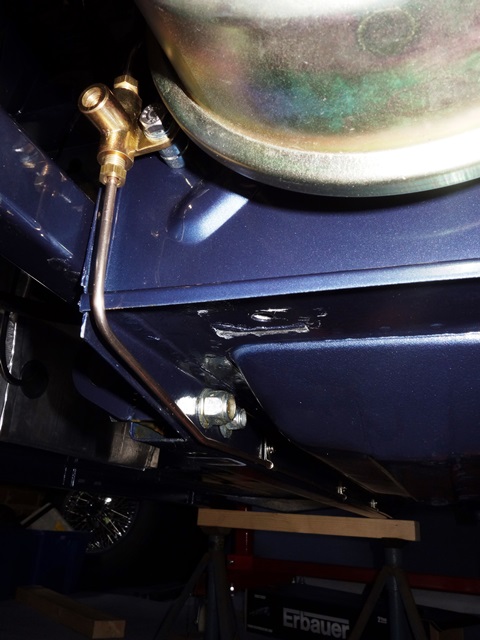
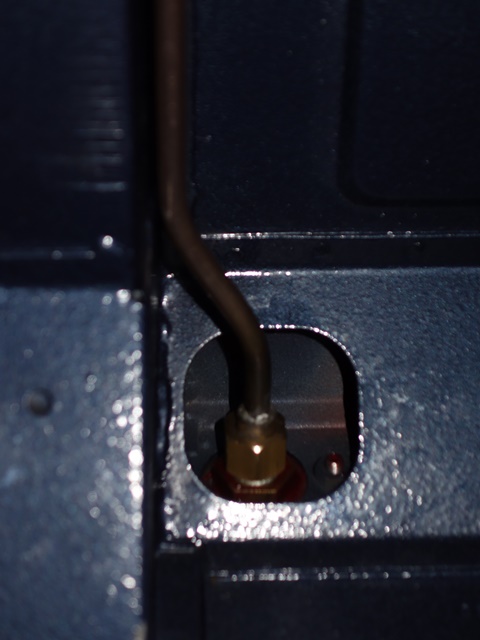
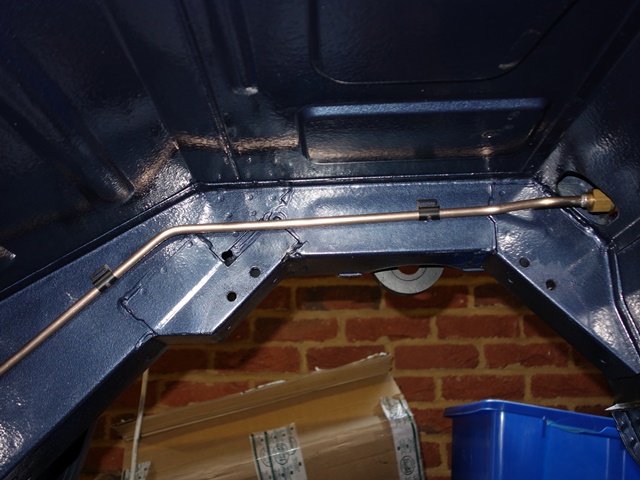
The fuel lines within the boot space are made of a hard, opaque, white nylon and exit via a union mounted on the far right of the rear bulkhead. Metal piping is then used between the union, around the rear axle mounting panel and along the underside of the chassis, to the fuel filter within the engine bay.

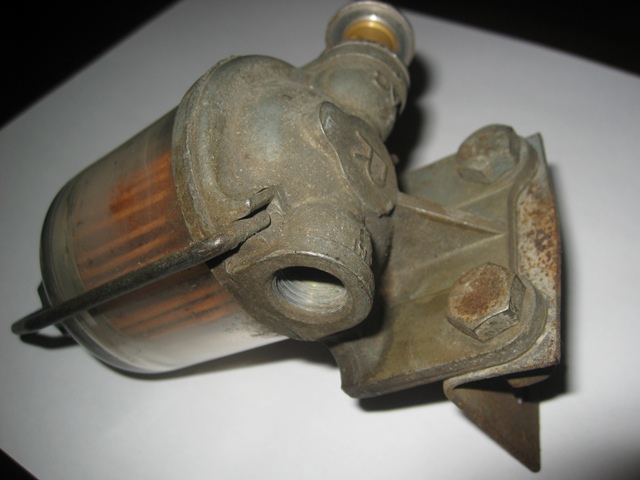
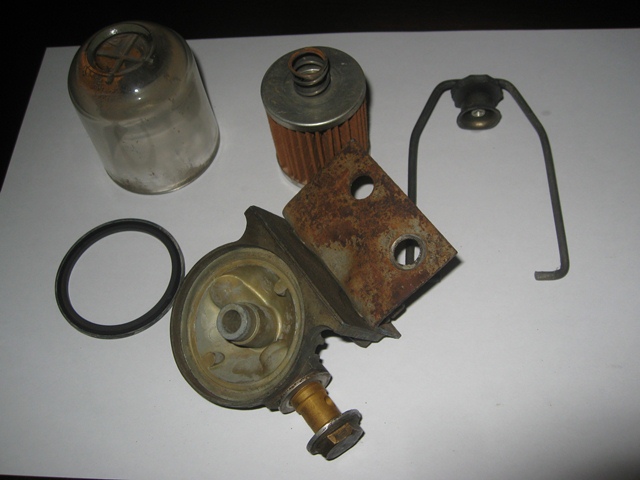
Fuel filter just needed to be cleaned up and the filter replaced Dismantling revealed only small amounts of deposited fuel residue

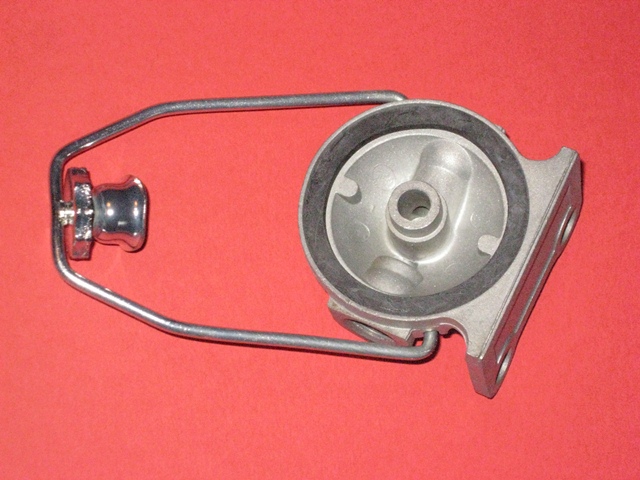
The filter and union just needed to be cleaned up. So the alloy body had the ultrasonic cleaning treatment to remove the fuel residue and the other parts zinc-nickel plated. Leaving the difficult part of bending the Cunifer fuel pipe ….

Ultrasonic cleaning brought the filter lid up nicely Cleaned and re-plated; the rear bulkhead union and filter assembly

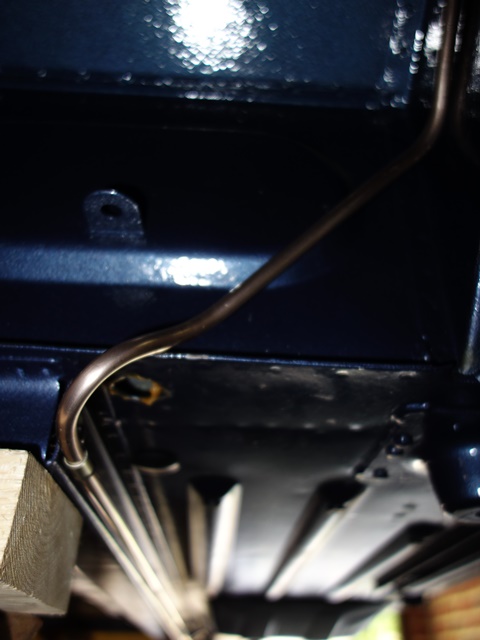
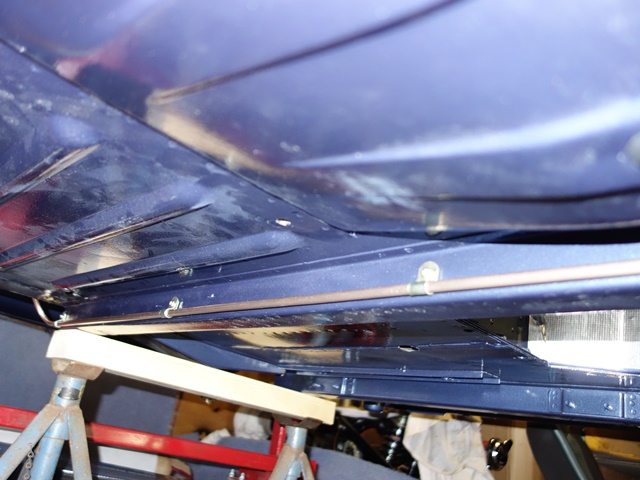
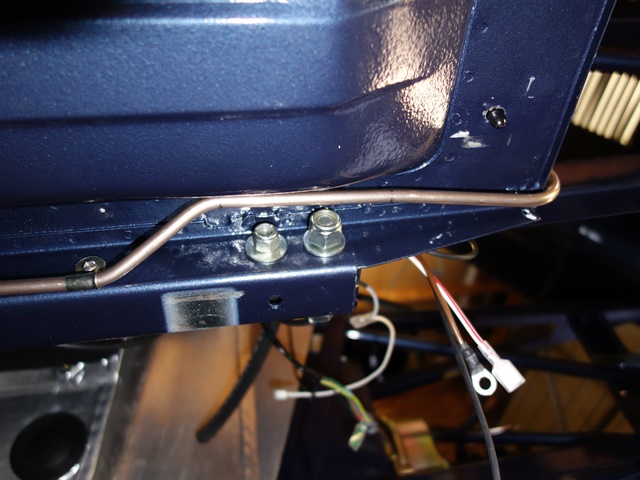
A 5/16″ diameter pipe is used for the fuel line so it is less forgiving than the brake pipes if minor tweaks are needed. The difficulty is that the entire section around the rear suspension cage needs to be bent into shape before it can be offered up. This involves bends in a variety of different planes, a sharper bends to then pass along the underside and ensuring the pipe passes through two retaining clips.

Fortunately I still had a slightly deformed original pipe to use as a template otherwise it would have been an altogether harder task. Again, as with the brake piping, I deviated from the original routing around the bolts for the torsion bar reaction plate. The only bit I’m not entirely happy with was the small section of pipe from the inline union in the engine bay to the filter which ought to be more horizontal. Still, it’s hidden by the vacuum tanks so shouldn’t stand out.

The good thing is that, now this pipe is in, the completed rear suspension cage can be fitted. Half way to a rolling chassis!!

Below are a few photos of the pipe routing:

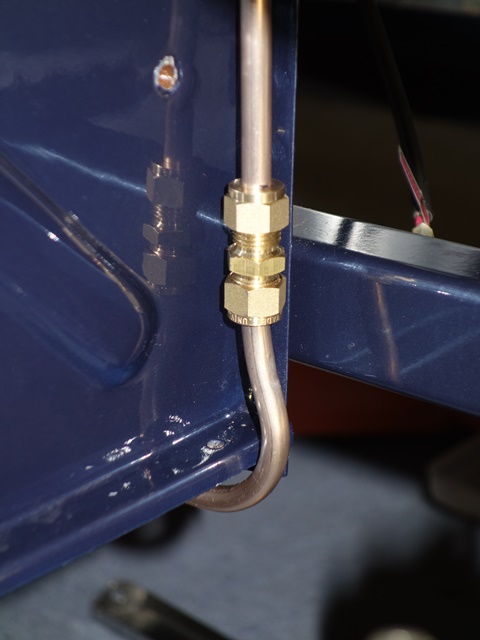
Bulkhead fuel union Around rear suspension Double curve to underside

5/16 Cunifer pipe is used for the external piping from the rear bulkhead union to the filter in the engine bay

From the union, the pipe follows the IRS mounting section

A double bend is needed to clear the welded floor/bulkhead flange

P-clips secure pipe to chassis Avoiding reaction plate bolts Double bend to inline union

The pipe then runs underneath the car, attached to the strengthening section with P-clips

The pipe was diverted around the reaction plate mounting bolts to provide access for spanners

Another double bend is needed to pass around the welded floor/toe box flange to an inline union

Inline union to filter

Finlly from the inline union, the pipe passes behind the reservac tank (not fitted yet) to the fuel filter

Jun 042013
 

An almost standard replacement for the front suspension lower ball joint is the later sealed for life units. Less so is fitting a modern upper ball joint as it requires the case hardened wishbone to be machined to fit. If wear occurs in the upper ball joint, it is often as a result of wear in the wishbone’s ball joint seat, which becomes more oval in shape.

After a lot of deliberation, I opted to change the upper ball joints as well, using a kit from CMC as the local machine shop agreed to do the necessary milling of the wishbones.

I was less convinced of their ability when the kit was taken round and thought it wise to seek someone else to do the work. The instructions suggest annealing by heating the wishbones to cherry red and allowing it to cool slowly. All the larger firms weren’t interested and the independent machinists were few and far between.

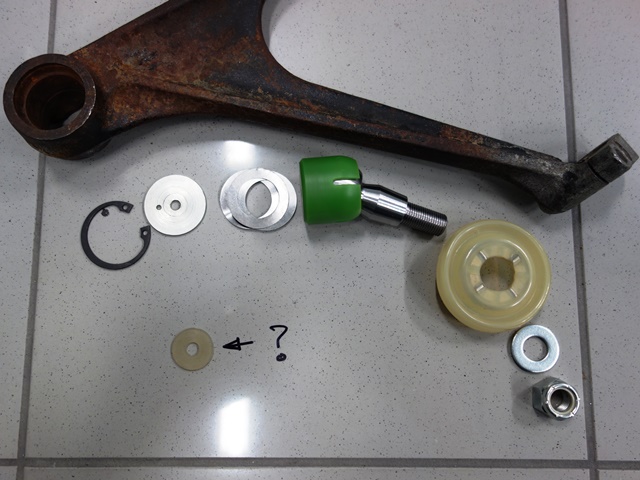
The components of the CMC ball joint kit, including the mystery small nylon washerIn my hour of need I turned to E-Type International Rescue – McLaren’s Skunk Work team. There was some bemusement as to why the kit contained a pack of 9 shims rather than machining the wishbones correctly.

Also the brevity of the instructions had not explained the need for a small nylon washer in the setup.

After a few discussions it was decided that a grease nipple inserted into the cover plate would protrude below the plate. So the kit included a nylon spacer and a similar depth of shims to allow for the depth of the nipple below the cover plate. Ideally the plate should have been designed accordingly rather than requiring shimming and therefore additional machining.

The wishbone was media blaster before profile milling to match the shape of the nylon ball joint cupThe ball joint bores were profile milled with a ball-ended tool around the circumference, progressively stepping down after each revolution until it had cut to the required parallel depth.

At which point the wishbones were machined to match the curvature of the green nylon ball joint cup by reducing the circumference with each step down.

I’m really pleased as I had precious little chance of fitting newer ball joints without their help. I now owe several loans of the car … once it’s finished!

The completed wishbone and new ball joint awaiting fitting of the circlip

May 192013
 

While researching the best piping to use for the hydraulics, I’d found out that copper piping is banned in many countries as it is susceptible to work hardening over time. I thought it wise to switch to Cunifer pipes as it is a safety issue, even though I had already purchased a copper pipe kit from Automec.

In the end I took the cautious approach to all the braking system and planned to have the master cylinder and servo units professionally renovated. The main reason being an inspection of the master cylinder had revealed some pitting and I wasn’t confident it would be possible to get a good seal without it being re-sleeved.

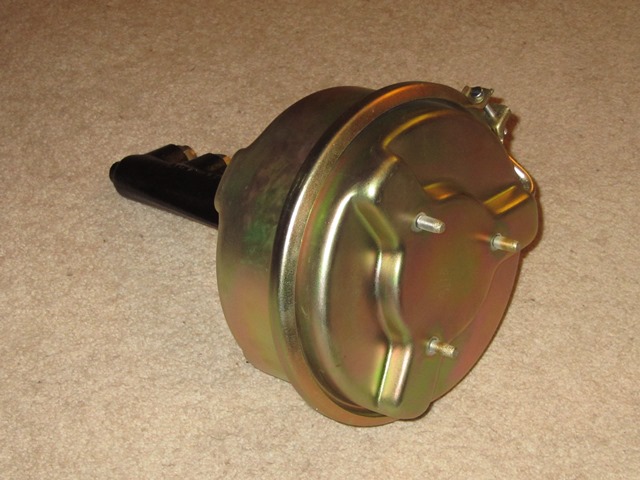
Also the fixing studs on the servo unit were all at odd angles so something was amiss. Opening up the servo uncovered a bodged weld ‘repair’ to one of the studs. The servo casing looked as if it had been fractured around the stud and so would need replacing. The units were sent off to J & L Spares to be repaired. However the cost of repairing the master cylinder was more than the cost of a new one so I opted for the latter.

Servo Mounting Studs Bodged repair weld Renovated Servo

The mounting studs for the brake servo were all at odd angles, suggesting all was not well

One of the studs appears to have been bent resulting in a fracture around the stud, whic had been poorly 'repaired'

A renovated servo unit from J & L Spares

Apart from a basic understanding, I’d never really paid much attention to the detailed workings of servo assisted brake systems. So it was out with the Jaguar service manuals to get a better understanding of how the vacuum boost is controlled. It should help if troubleshooting is required later on, especially as I will be tapping into the vacuum circuit for the EDIS Megajolt control module.

It’s actually quite simple. A reservoir tank stores a ‘vacuum’ by being connected to the inlet manifold, which is at a lower pressure than the ambient air pressure. This is then used to boost the braking force when the brake pedal is pressed.

The servo unit contains to volume chambers which are both connected to the vacuum reservoir but separated by a diaphragm. The servo hydraulic piston is operated by fluid forced from the master cylinder but also by a spindle attached to the centre of the diaphragm.

At rest when no braking force is applied, there is no flow of hydraulic fluid and both chambers are at equal pressure and so no force is exerted on the piston.

However when the brake is applied, the master cylinder piston is pushed down the bore forcing fluid from the master cylinder to the servo unit. This operates the servo hydraulic plunger. Near the end of the travel of the master cylinder piston, it operates a reaction valve.

The reaction valve first disconnects the servo’s rear chamber from the vacuum supply and then opens the rear chamber to atmospheric pressure. This creates a pressure difference between the front and rear chambers, which forces the diaphragm and attached spindle forward. Thus increasing the force applied to the servo hydraulic piston.

Once these were installed on the car, it was time for the fabrication of the hydraulic piping ….

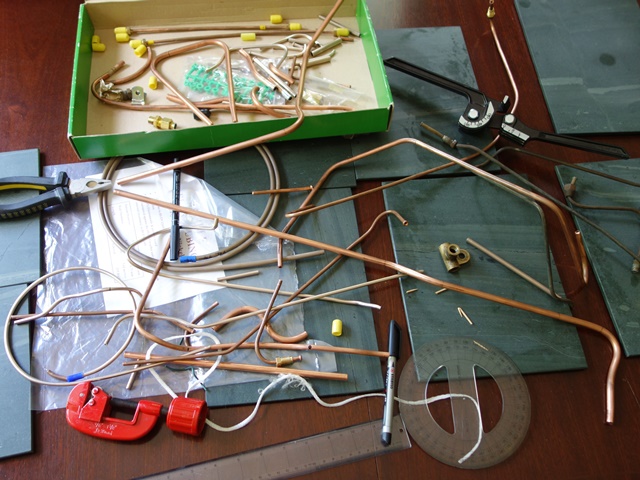
The brass fittings were salvaged from the Automec kit and the copper piping used for making mock-ups of the more complex sections. Cunifer piping is typically sold in 25 foot coils which was more than enough. So I had plenty spare ‘just in case’ I made a hash of making the individual pipes.

I now needed to straighten the replacement Cunifer piping and also to obtain a brake flaring tool. Initially I purchased a flarer from Machine Mart which was little short of useless and had the typical Made in China quality about it. I ought to know better by now!

There’s always a number of old, quality flaring tools on eBay but these usually change hands for well in excess of £100. I think people just resell them back on eBay once they’ve finished their restorations, which is what I planned to do. However after being outbid on numerous times I gave up as I needed to press on.

The Oakes brake flaring tool purchased from Automec was well worth the investmentAfter a recommendation, I picked up a new Oakes tool from Automec at the Jaguar Spares Day for a show price of £90. Quite a bit for a tool for a one off job but it does produce good, consistent flares every time. All in all, a good investment and a quality tool.

I’d previously straightened all the copper piping over a form (covered in a previous post) but subsequently disposed of the wooden form, thinking I’d no longer need it!

I did come across a straightening tool produced by a company called Kwix UK which seemed promising. However it only straightens a pipe of a fixed diameter so I’d need three tools for each of the pipe diameters used for the brake and fuel lines.
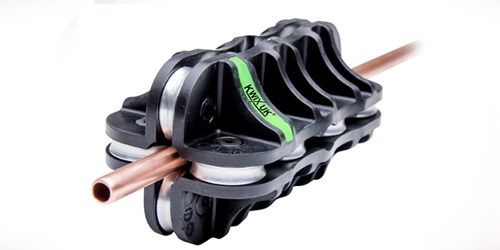
One to avoid - the Kwix UK pipe straightener - it could be a good product but really let down by their customer serviceThe 1/4″ brake pipes linking the master cylinder and servo run around the engine frames. I thought any slight bends/kinks in these pipes would be more noticeable as they run along the straight edges of the frames. The 1/4″ tool was purchased as a trial and it worked well so I got the 5/16″ one for the fuel lines.

Unfortunately this time, the pipe passed straight through without a hint of straightening and emails to the company received no response. I think they probably just sent the wrong sized tool but couldn’t be bothered with addressing customers’ issues so I won’t be dealing with them again!

The difficulty with bending the pipes was that often it wasn’t possible to trial fit the pipe after each bend was made. The unbent length would usually foul some part of the bodywork, stopping the pipe being placed in situ to mark the exact point for the next bend.

There was little margin for error for pipes that had to be bent in different planes. It only takes slight errors in the position of the bend, the angle of the bend or the plane in which the bend is made for it not to fit and the errors are magnified once another bend or two is added.

The clutch and rear brake piping, although the photos don't quite capture the various bends in numerous different planesThe mantra measure twice cut once applied here as, once bent, it’s almost impossible to re-straighten a pipe, especially the larger diameter piping. In fact it was more like measure 10 times, bend once! I probably had to discard just under half of my first attempts.

Having completed the hydraulics, I’m not convinced of the wisdom of purchasing kits as it would be nigh on impossible to get all the pipes right first time. So I’m glad I decided to fabricate my own pipes and it was quite therapeutic.

Having said that, I still managed a few numpty moments. A couple of times I allowed the brass fitting to slide away from the flared end onto the wrong side of where the bend was then made. Another scrapped length of piping!

The copper kit didn’t go completely to waste as it was cut down into shorter lengths and used to get correct position, angle and plane for a small section with say 2 or 3 bends. This could then be offered up without fouling the bodywork before making the same bends in the full length of pipe.

I had all but a few of the original pipes to use as templates however I did deviate in a couple of areas:

  • The pipe to the rear runs along the under floor box section but divert so it is clear of the mounting bolts for the torsion bar reaction plate. In doing so I think the pipe would be more exposed to damage. I continued running along the box section and will just need to take care when doing up the torsion plate bolts.
  • I thought it looked neater having straight piping around the front of the engine frames rather than trying to get them to mirror all the rises and falls in the frame profile. Therefore, just before the front brake union, the smaller front brake pipe jumps over the larger pipe rather than underneath.

Also my pipe bender couldn’t get as tight ‘U’ bends from the brake and clutch master cylinders and other methods were prone to causing the pipe to start collapsing.

Hydraulic Pipe Routing
Below are a few photos of the trial fitting of the various hydraulic pipes on the S2.

Clutch from Master Cylinder Clutch low pressure pipe

The routing of the clutch piping from the master cylinder to the flexible hose union. Note - not fitted at this stage is the P-clip on the LH frame bolt, securing the pipe

The clutch low pressure hose has a tight U-bend before running parallel with the engine frame

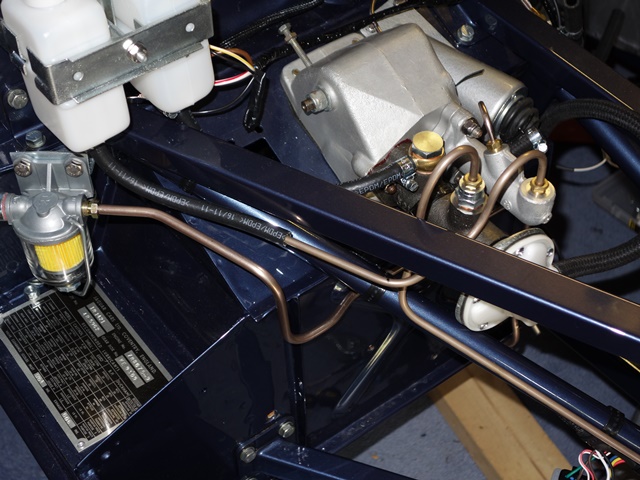
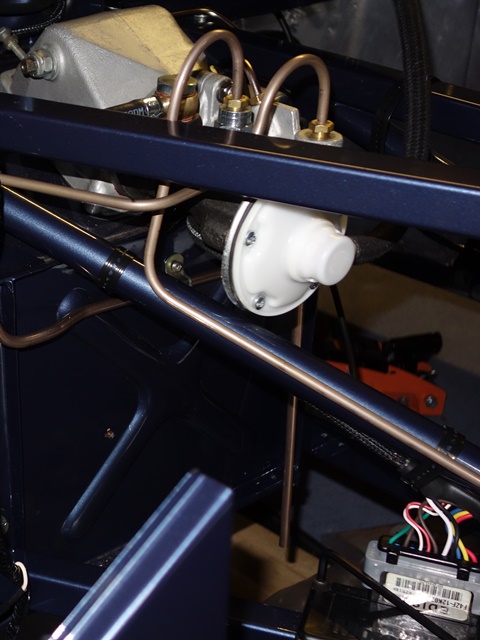
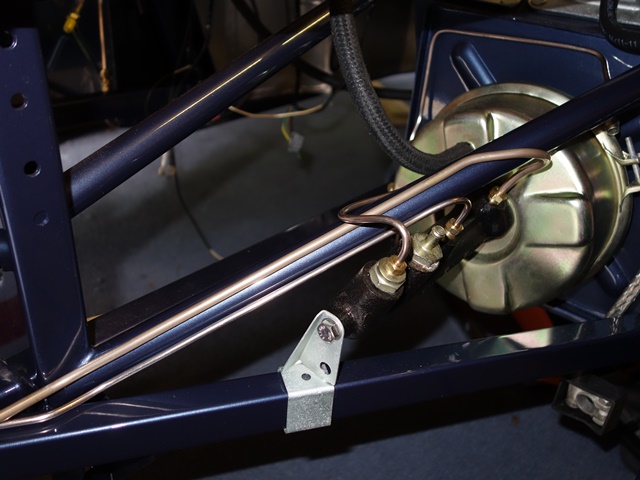
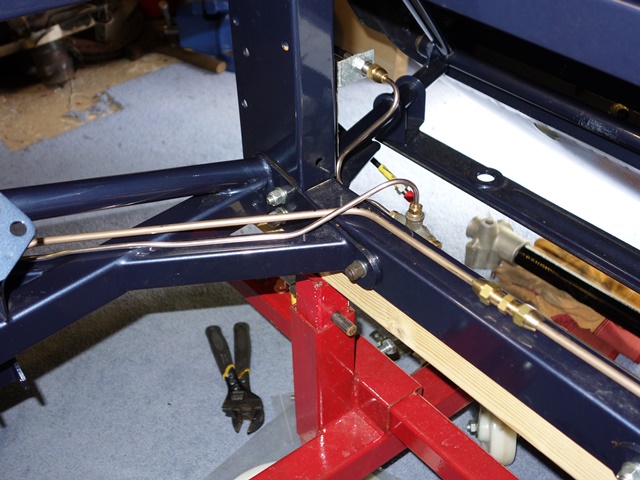
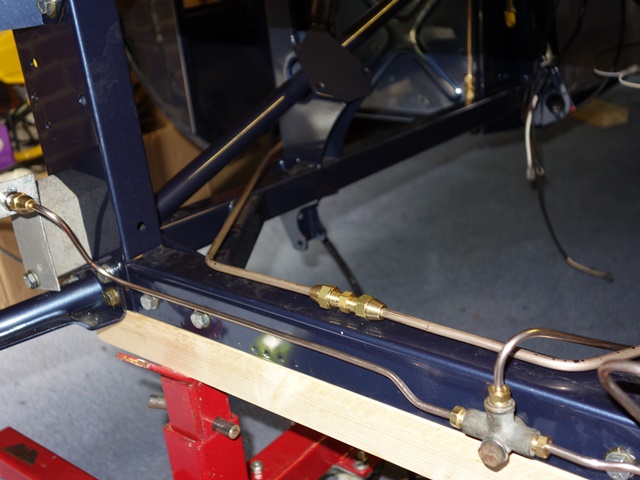
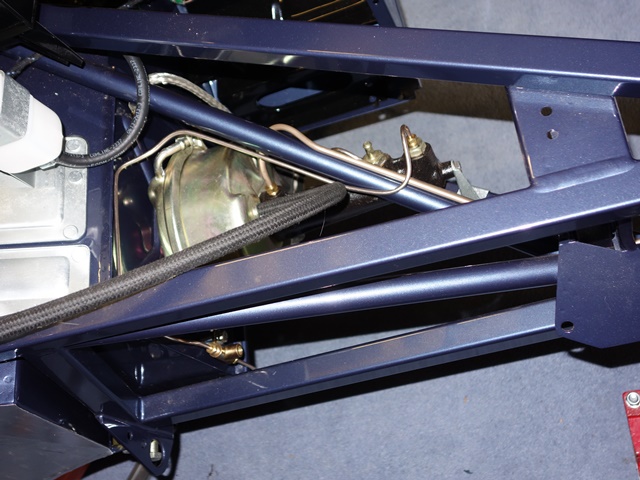
Brake – Master to Servo Brake – around Picture Frame Brake – Master to Servo & To Front

The brake pipe from the master cylinder to the servo unit also has an initial tight U-bend before running down the diagonal, round engine frame

The pipe then routes around the bottom of the picture frame to an inline union

From the union, the pipe travels up the opposite side frame member to the servo unit.

Front feed over Master to Servo Left Front Brake Righr Front Brake

The feed fro mthe servo to the front brakes first passes underneath the thicker master to servo pipe and then over it to the front union

The left brake pipe from the front union

The right brake pipe from the front union

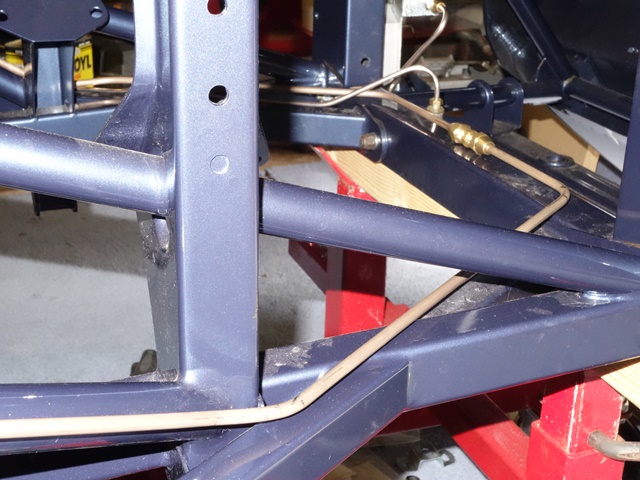
Servo to Rear Union Union to Rear A few off cuts!!

The path of the pipe for the rear brakes from the servo to an inline union, which includes the brake light hydraulic switch

From the brake light switch union, the rear pipe passed down the LHS of the underside of the car

The fitting of the clutch and brake pipes was definitely a case of practice makes perfect - a few off cuts!

May 092013
 

The thickness of the pipe insulation hindered the positioning of the rack in the bulkheadThe final item to install within the bulkhead was the wiper rack, which really ought to be very straight forward. However the thickness of the heater pipe insulation I’d used caused problems again. The reduced clearance stopped the entire rack to be fed into the bulkhead as one unit.
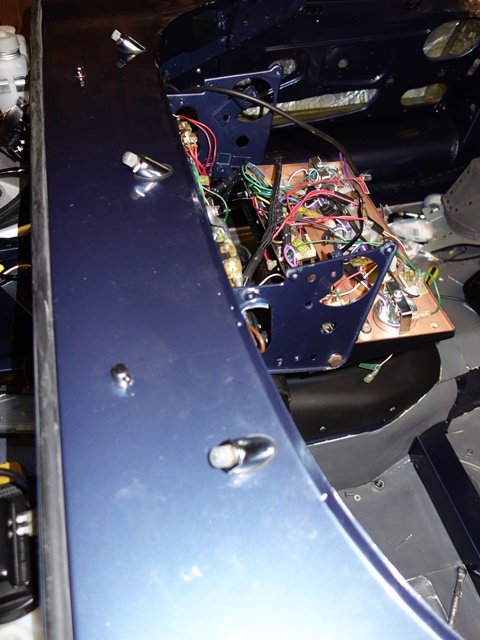
After several attempts using different angles/orientations, I conceded defeat and decided the quickest method would be to build the rack in situ.

The obvious issue being that if anything is dropped it could be a real problem fishing it out, now the pipes are all in place.

The two end splined drives were detached from the main rack frame so they could be losely fitted separately. No matter what I tried, I then couldn’t get the central splined drive and main rack frame to fit onto the two ends.

Some head scratching later and my laughable error became clear. I was trying to fit it the wrong way round, with the splined drives facing the screen rather than away from it! Muppet!

An end splined drive reconnected with the main rack frame The wiper rack finally fitted the correct way round!!

Once corrected it, unsurprisingly, fitted without any issues. The final fettling of the adjustable links and connection to the motor will be done once the screen has been put in place.

 Posted by at 9:57 am
May 092013
 

There’s little worth noting regarding the fitting of the windscreen washer and jets. Fortunately the chromed jets were the first thing I’d decided to install before the bulkhead pipes and wiper rack, which made it possible to fish out dropped washers and wing nuts.

The washer plumbing was left until all the heater and vacuum pipes were in place to avoid it getting in the way.

I managed to succeed in making life hard for myself by putting the washer jets in place and then attempting to fit the washer and wing nut one handed from underneath.

I’d lost count of the number of times I’d dropped either the washer, the nut or both. Finally common sense prevailed.

They could easily be moved and held in position by placing the wings of the nut between the forefingers and balancing the washer on top. The washer jet can then be screwed in from above until it had engaged with the nut, then finally tightened up from below.

My decision to insulate the internal bulkhead heater pipes also caused problems with the routing of the washer piping through into the bulkhead. The heater pipe passes very close to the hole for the washer piping and so the insulation was blocking the way.

Finally, to keep the tubing neat and tidy and away from the moving parts of the wiper rack, it was zip tied to the wiper rack frame.

May 072013
 

Several weeks ago I’d dropped off a box full of parts, including the heater and vacuum pipes, at the local powder coaters. Rather timely, they were ready for collection just before the bank holiday and one with fair weather forecast to boot! A good chance to crack on.

Fortunately you can’t go wrong with the orientation of the heater pipes and the vacuum pipes are fairly obvious. One vacuum pipe is straight (V2 in the photos) and one has a slight kink (V1) to bypass an entry point in the bulkhead. The entry point was originally blanked off so I assume this must have been for air conditioning or a fitting for LHD cars.

The fitting sequence is also obvious, working from the bottom up: H1, V1, V2, H2 and finally H3. My three heater pipes were new so I’d had a trial fitting of all the pipes and the bulkhead flanges so I wasn’t expecting too many headaches.

I’d picked up three tips from the E-Type forum from others who had gone through the same process:

  • Insulate the heater pipes to stop unwanted heat within the bulkhead
  • Use tape around the flanges to protect the paint when riveting
  • Feed rope or cord through the pipe so, when pulled, it would force the pipe flanges hard against the inside face of the bulkhead

All seemed sensible advice so I purchased some dense foam, pipe insulation. The other issue I’d already found was that the shoulder of the rivet gun was too wide to get the mussel onto the rivet head.
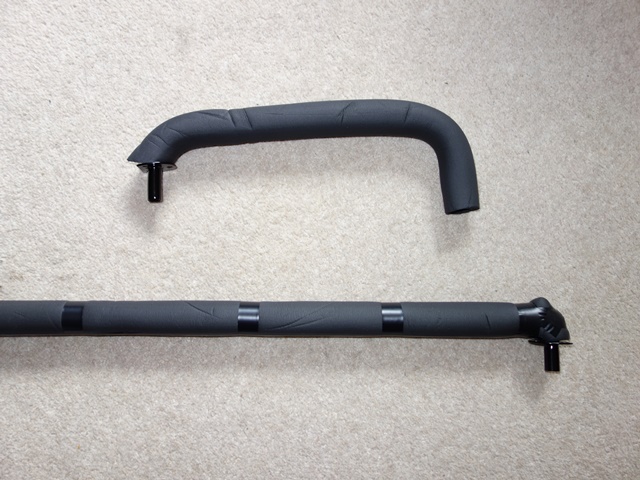
I spent a while looking for alternative rivet guns before someone pointed out the obvious; grind down the side of the rivet gun to reduce the width. A few minutes on a bench grinder and I was all set.

The first of many headaches was that I’d decided to route the vacuum and wiring cable for the EDIS Megajolt ignition within the bulkhead void. So this had to be removed temporarily to provide enough space to work. As I’d previously waxoyled the bulkhead, the whole process was a very messy business!

The tip of feeding rope down the pipes was really helpful. I fed a long length of garden wire down the pipes and, in Heath Robinson fashion, tied the ends behind me. I could then lean back pulling the pipes against the bulkhead while having my hands free for riveting.

Even so, I still managed to miss out the pipe flange when I riveted one end of the first pipe. The exterior flange was securely fixed to the bulkhead while the pipe was free to move!

I ended up cursing the fact that I’d insulated the lower heater pipe. At least I probably should have used much thinner lagging. It made the fitting of the lower vacuum pipe so much harder and later the routing of the windscreen washer tubing.
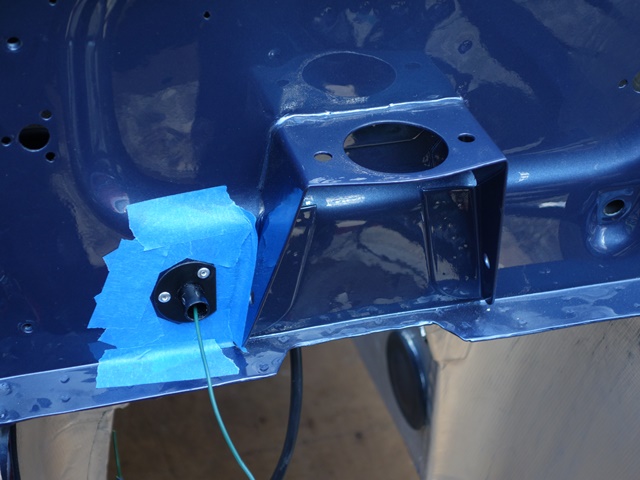
Even though I’d trial fitted the pipes, when it came to actually fitting them, I had problems aligning the holes in the two flanges and the bulkhead for every single pipe. I’d passed a 3.2mm drill through each hole as the pipes had subsequently been powder coated but still there wasn’t enough tolerance.

I’m also glad I taped the surrounding area as the head of the rivet gun tends to jump off the rivet when the pin snaps. I’m sure I’d have had several chips without it. In fact the only touching up needed was to one of the flanges but this was more to do with the adhesion of the Hammerite to the zinc plating.

Initially I’d only ground down one side of the rivet gun mussel. This was fine for the right hand ends of the vacuum pipes but useless for the gun orientation needed for the left hand side. Rather than stop and grind down the gun, I had a numpty moment and decided to fit the other heater pipes above before returning to finish off the troublesome vacuum pipes.

The pipe insulation was causing issues fitting the left hand side of the lower vacuum pipe so I thought I’d have to remove it. With the heater pipes fitted above there’s was no chance of getting at the vacuum pipes. So I just had to struggle on and finally managed to rivet them in place.

If I had the misfortune to have to do this again I wouldn’t bother with the insulation on the lower heating pipe, I’d waxoyl after installation and only move on to the next pipe once the lower one is completed. At last the long running saga of the bulkhead heater and vacuum pipes was over!!!

Now I can get on fitting the bulkhead components …..

Update: I’ve since read on the E-Type forum that uninsulated heater pipes can deliver sufficient heat to soften the surrounding waxoyl so it becomes runny and can drip everywhere. Therefore it’s probably is wise to insulate the lower pipe after all.