A milestone is reached – back on 4 wheels … almost!!

 Front Suspension  Comments Off on A milestone is reached – back on 4 wheels … almost!!
Sep 042013
 

The issues getting the rear suspension fitted meant that there wasn’t time to fit the front suspension let alone the engine.

The front frames were removed to fit the tiny radiator support brackets. As the frame bolts pass through the front suspension mounts, these and the roll bar were refitted at the same time as the frames.

I must mention to Andy at Hutsons that it would be a good idea to fit the radiator brackets on S2 cars before bodyshells are returned to customers.

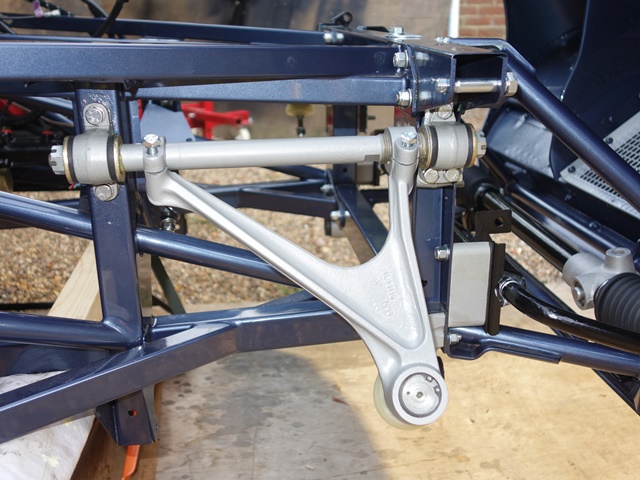
I started with the easier upper wishbones and found the castellation nuts need to be fully tightened to compress the rubber bushes. This pulls the front and rear fulcrum mounts together so the bolts holes line up.

The original camber shims had been re-plated and were fitted behind the front and rear mounts. I suspect the shimming will need to be changed when the geometry is finally set up because the new engine frames have been fitted.

At least it should be a good starting point. The rear mounts also have a strengthening plate fitted on the reverse side on the engine frame, under the nuts. One of these was missing so I suspect at some point the suspension had been dismantled and they’d forgotten to refit it.

The castellation nuts were then backed off as they should only be fully tightened once the full weight of the car is supported by the suspension to avoid damaging the rubber bushes. The wishbone pinch bolts were also not tightened as the fulcrum shaft will need to be rotated during the final setup to set the castor angle.

The upper wishbones were fairly easy to install as they simply bolt on The lower wishbones were much harder as both the front and rear mounts need slotting into the engine frame

For now the aim is to get the car back on four wheels so it can be moved around more safely. The front suspension can only be completed once the engine has been installed when the torsion bars are fitted. This will require the upper ball and steering arm joints to be separated. So at this stage, only the lower ball joint was fully tightened. Without the torsion bars the car should just settle on the shock absorber bump stops.

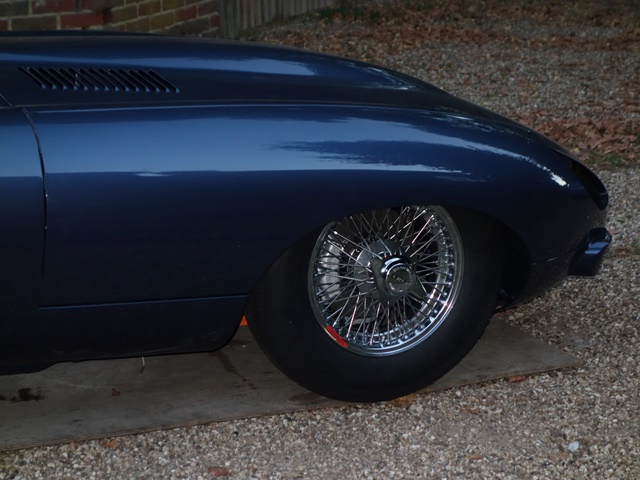
The moment had arrived. The lowering of the car back on to its own four wheels. Something that hadn’t happened for many, many years. The trolley jack was lowered very gently …. touch down (pats on back etc) …. then lower …. and lower …. and lower …. and so it carried on. I had to close the bonnet and control the jack from underneath but I was getting worried that the bump stops wouldn’t be reached. Do they even have bump stops?!

Will the bump stops ever be reached? ..... No! The car had to be put back onto the axle trolley.

The trolley jack finally reached it’s lowest height so I had to revert to Plan B – back on to the axle trolley until the engine and torsion bars are fitted. Ho hum …. a FAIL! I really should have just measured the compressed shock absorber length when it was off the car and then done some simple Maths. Another lesson learnt!

Handbrake rebuild

 Brakes  Comments Off on Handbrake rebuild
Sep 022013
 

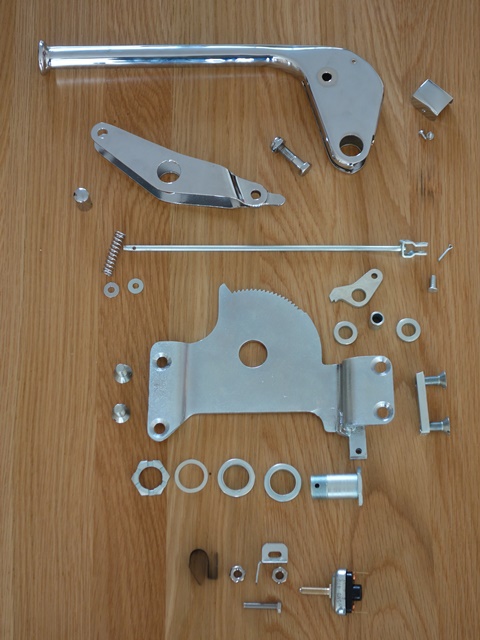
The re-plated handbrake component ready for assemblyThe handbrake had been sent off to ACF Howells for re-chroming as a complete unit. With hindsight it would probably have been better to dismantle it myself and just send them the pieces that needed re-chroming.

I therefore had to work out how the pieces should go back together. The original fittings for the handbrake light switch were missing from the car so the replacement parts would also be added to the puzzle.

Fortunately most of it is fairly self-explanatory. The only issue was having to cut down a roll pin to replace the retaining pin for the push button which wasn’t in the parts returned after re-chroming.

The first task is to reunite the push button operating rod and the pawl of the ratchet mechanism within the handbrake arm. The operating rod is fed through the access hole at the rear of the arm and the pawl is inserted up through the base of the arm, complete with its distance tube and a spacer either side.

Orientation of the operating rod & pawl A clevis pin connects the rod & pawl

The pawl needs to be orientated with the hole for the clevis pin rearward so the hole and fork end of the rod can be manoeuvred to protrude through the access hole in the arm. The clevis pin can then be inserted and secured with the split pin.

The push button needs to be fitted before the pawl pivot bolt, otherwise there’s not enough clearence to insert the retaining pin. Without the bolt, the operating rod can be pushed down the handbrake arm until the hole for the retaining pin is clear of the handbrake arm.

At rest the pawl is held in the locking position by a spring which is inserted onto the operating rod before the push button is fitted. The order of fitting is a washer (not shown in the photo) which sits against protrusions inside the handbrake arm, the spring, a retaining washer and then the push button.

Sprung push button components Roll pin inserted to secure button
The operating rod needs to pushed so it protrudes beyond the end of the handbrake arm (further than in the photo!) so the retaining pin can be inserted Copious amounts of grease was applied before the roll pon was hammered home

A forum member had a thin rubber washer between the second washer and the button. As a rubber washer wasn’t in the returned parts, I can’t be sure if my handbrake originally had one. When the button is fitted the spring is already under compression, providing a cushioning effect and wear isn’t an issue. Therefore I didn’t feel the need to fabricate a rubber washer.

Next the ratchet gear needs to be inserted into base of the handbrake arm followed by fitting the outer cable attachment bracket. Similar to the pawl, the ratchet gear uses two spacers to fill the internal space within the handbrake arm.

The two bolts securing the outer bracket can then be fitted. One acts as the pivot point for the pawl and the other as the pivot for handbrake arm in relation to the ratchet gear.

The final piece in the puzzle was the fitting of the handbrake warning light switch. As mentioned, these parts were missing and so replacement parts were ordered from SNG Barratt.

It looked fairly obvious how things went together. A bracket mounts the switch to the base of the handbrake ratchet gear and it appears that a ‘S’ shaped spring attaches to the end of the switch.

When the handbrake is fully released, a ‘finger’ protrusion at the bottom of the outer cable attachment bracket presses against the spring, which in turn depresses the Push-to-Break switch.

The parts manual indicates two nuts are needed to secure both the spring and the switch. I’m obviously missing something as I can only see how to get it to work using three nuts – one to secure the switch to the bracket and two half nuts to lock the spring at the correct distance from the activating ‘finger’.

Trial fitting the exhaust

 Exhaust  Comments Off on Trial fitting the exhaust
Aug 242013
 

The exhaust system is another area where there are a plethora of options available and with them, opinions on which is best. These range from a standard bore with cast manifolds through to straight through, big bore pipes with either long or short tubular manifolds and all combinations in between. Advice often just reflected what the owner had decided to put on their car rather than comparative tests.
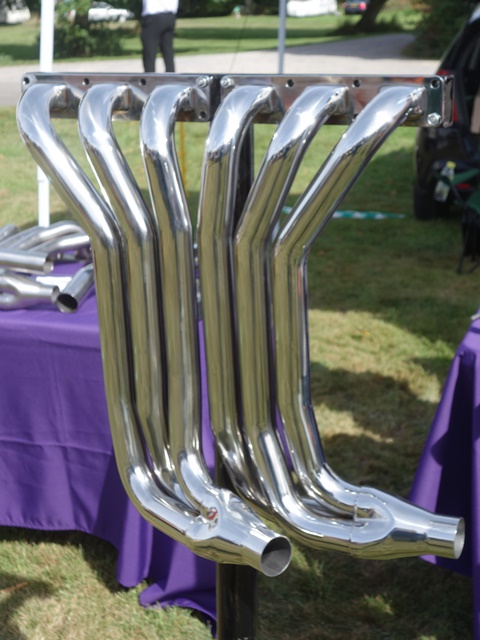
The Classic Fabs long tubular manifoldsIt was tempting to go for one of the tubular manifold systems from companies like Classic Fabs, which are a work of art.

However the administrator of the E-Type forum had done a fair amount of research backed up by practical experience, having fitted most of the different types available.

The general consensus from the forum discussion was that the original cast iron manifolds were very well designed; providing optimised gas flow to speed up the exhaust gases therefore improving low down torque but also heat management. The larger bore systems, specifically when used for the secondary pipes, can result in a torque dip lower down in the rev range.

The other issues are that they are more prone to grounding and tubular manifolds generally radiate far more heat which is then likely to cause other problems, such as brake issues due to the proximity of the brake servo and blistering of the paint work.
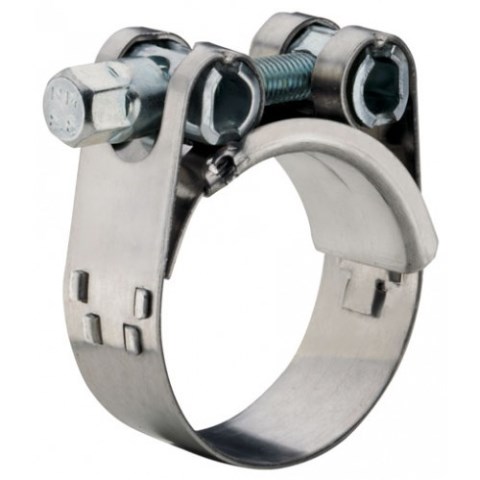
The Mikalor style clamps were used instead of the typical U clampsIt therefore seemed sensible to stick to the standard cast iron manifolds and 1.75″ bore system, which was purchased from PD Gough based in Nottingham.

I’d also decided to deviate from the original look at the rear after seeing others who had successfully avoided the slab-like appearance by removing the rear, brushed aluminium panel. The car will be fitted with a long rather than square number plate which enables straight exhaust resonators to be fitted instead of the standard S2 splayed ones.

The final decision to make was whether to have the system made in mild steel or stainless steel. Apparently mild steel gives a much nicer exhaust note but in the end I went for stainless for longevity. Another recommendation that I also adopted was to fit Mikalor style clamps as they apply the clamping force more evenly and avoid distorting the pipe joints.

Some ‘reject’ manifolds were picked up quite cheaply at the SNG Barratt open day – they had some tiny imperfections in the vitreous enamel finish which I still struggle to find. This finish was never very robust and had a tendency to crack and flake off. So I’m expecting it won’t last too long and will need to be removed in order to paint/treat the manifolds.

The engine installation weekend was fast approaching so I decided to trial fit the exhaust system. At this stage, without the engine in place, all that could be trial fitted was from the muffler section backwards.

The combination of not having the down pipes installed and the car being on axle trolleys meant it was extremely difficult to build the exhaust on the car. The pipe ends were unblemished so the system clearly hadn’t be bench fitted when it was manufactured. Therefore all the joints were still very tight even with a generous coating of Copperslip.

It was necessary to build the system off the car to have any chance of aligning the brackets on the intermediate pipes and to push the resonator pipes fully home to be able to mount them onto the rear hanger.

It was then fitted as a single unit, first fitting the muffler section to the four rubber mounts fixed along the chassis rails. I was struggling underneath the car trying to hold up the exhaust up to the mounts while feeling for the 1/2″ spanner that I’d dropped when I noticed I had an audience – a metre long grass snake was observing my progress a couple of feet away. I assume having taken refuge from the hot, sunny weather.

Mounted centre muffler section My new helper! Resonator pipes mounted at rear
The muffler section fitted fine .... until the resonator pipe were mounted which caused it to rise at the rear A grass snake had sought shelter from the hot, sunny weather The resonators had to be pushed upward with a fair amount of force in order to attach to the rear mount

The connecting brackets between the intermediate pipes and the resonators were all fixed so the whole exhaust was now quite rigid. The muffler section was already mounted but the resonators needed a reasonable amount of effort to push them up to reach the rear exhaust hanger. In doing so, it caused the muffler section to raise significantly at the rear so the output pipes hit the rear floor stiffener.
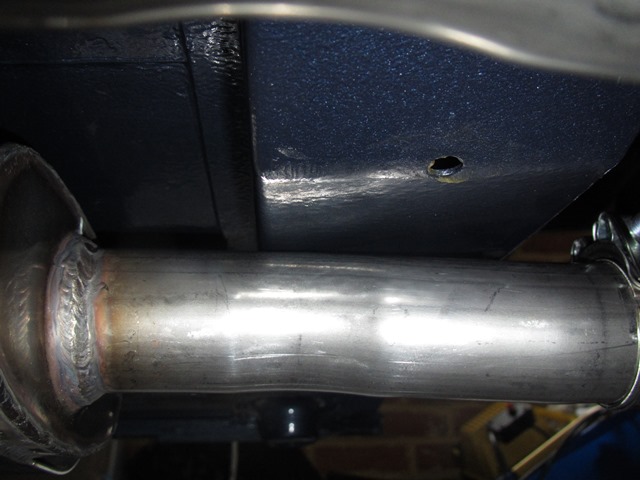
The output pipes from the muffler section foul the rear floor stiffener so something's amissIt didn’t seem right because the small rubber mount at the rear would be under considerably more stress than just supporting the exhaust’s weight. Apart from varying how much overlap there is in each joint, there is no other scope for adjustment and the geometry is fixed so, without modification, the pipes would almost certainly foul the rear floor stiffener.

I emailed PD Gough with the photos above explaining the issues I was having and the purpose of the trial fit was to ensure it fitted correctly before the engine installation weekend. I didn’t want to find out it didn’t fit during the installation weekend and therefore stop the testing of the engine.

I felt their response was more of a fob off and so wasn’t too impressed – “they’d never had any fitting issues before and would be surprised if I had fitting problems once the front pipe are fitted as they would generally bring the system into alignment”.

Personally I’m not convinced because the front pipes are flexible and so their ability to bring the whole exhaust into alignment would be limited. Also the forcing of the muffler section towards the horizontal to stop the clearance issue will only add to the stress on the rear rubber mount.

I’m going to be extremely annoyed if I end up having to ‘surprise’ them by informing them it doesn’t fit.

Building up the front suspension

 Front Suspension  Comments Off on Building up the front suspension
Aug 152013
 

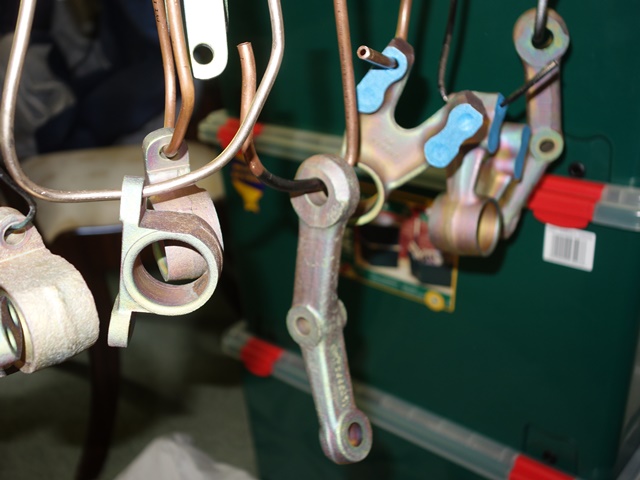
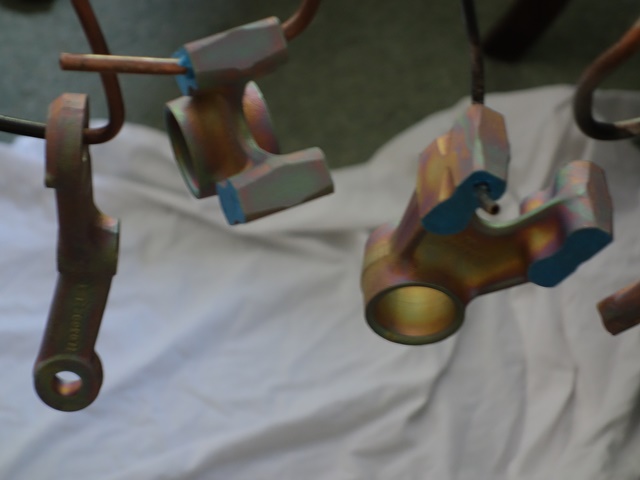
The plating didn’t go quite to plan as I hadn’t expected (or asked!) for the parts to be yellow passivated so the final look wasn’t really what I had in mind. The photos below show the ‘oil slick’ appearance that comes from the yellow passivation. Another lesson learnt – don’t assume anything and be explicit in your requirements!

I’m sure they used it with best intentions, as it provides slightly greater protection, or it’s the default colour but I’m kicking myself now. Still a number of people have advised on painting rather than plating for a more durable finish – now I’ll have the best of both worlds!! Anyway the aim is to drive the car rather than polish it for show!

The bracket faces that are in contact with the engine frames and the fulcrum shafts were masked to avoid any clearance problems later on. All the suspension parts were then given three coats of aluminium Epoxy Mastic 121. The parts were left for a couple of days to allow the paint to fully cure and harden.

It was also time to come off the fence as I needed to decide on whether to use the standard rubber bushes or install ‘upgraded’ polyurethane ones, such as Superflex. I’d fitted polyurethane bushes on my Elise but after several years the bushes would squeak going over even the slightest road imperfection. I think this was probably largely due to the garage not applying the correct grease (if any!) when they were installed.

In the end I’ve decided to keep to the standard rubber bushes, which were fairly easy to press in the bushes using a vice and liberal amounts of washing up liquid.

Standard rubber bushes were used in the end rebuilt wishbones and uprights ready to go on Sealed for life XJ40 lower ball joints were used

I’d been toying with the idea of buying a hydraulic press since the start of the restoration but, each time I’d needed one during the rebuild, the job was farmed out. I couldn’t justify the cost of a press now, at such a late stage, and so took the front uprights, hubs and a print out of the suspension section of the manual to the local garage while I built up the wishbones.

I hadn’t felt the need to state the obvious, that the hubs have different handed threads, because they were clearly labelled ‘LH’ and ‘RH’. Sure enough, when I picked them up a couple of days later, they had put the hubs on the wrong way round! What was that about not assuming anything and being explicit in my requirements!

I thought it would be easier to sort that out once they’re on the car and set about finishing off the simple task of putting the upper and lower wishbones together.

Finally the sealed for life XJ40 lower ball joint units were fitted to the uprights. Far easier than the original set up which required shimming. The suspension parts are now all ready to be bolted on next weekend.

The plan was to install both the front and rear suspension, steering, the engine and gearbox and all the engine bay components with the aim to get the engine running. Unfortunately I’ve not managed to sort out the dreaded fuel tank yet so the testing of the engine will have to wait.

Aug 122013
 

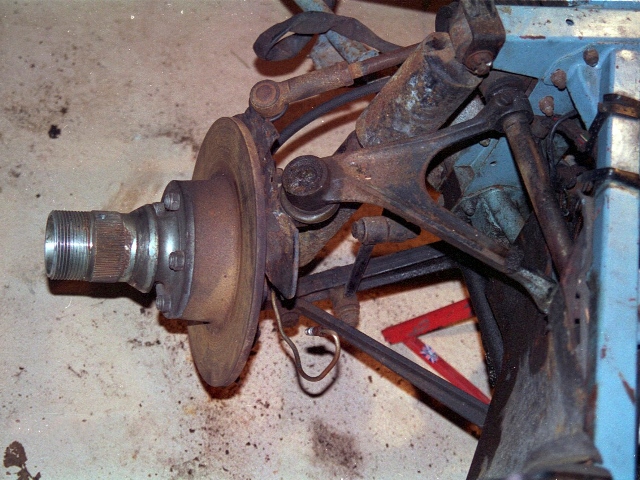
The dismantling of the front suspension was by far and away the hardest part of the stripping down. I suspect it had never been apart since it left the factory and hadn’t seen much in the way of maintenance.

The only parts that could be removed were the two upper wishbones. It took some fairly heavy blows with two club hammers to get the ball joints to split it. The rest of the suspension had to be taken off the car in one piece so it could be soaked in penetrating oil for many weeks.

Front suspension had seen little maintenance Dismantling was easiest off the car Axle carrier limited access to the lower ball joint

Even after that time, it hadn’t made the slightest bit of difference and all the bushes and bolts were still refusing to come off. I tried to press out one of the shock absorber bolts that also hold the two wishbone arms together. However all I succeeded in doing was to bend the bolt!

Progress was painfully slow and often I would get to a part that wouldn’t budge no matter what I tried. So I’d put it to one side and come back to it in a week or so, with renewed vigour. Eventually, over three months later after applying everything from penetrating oil, heat, cold, fire and a lot of frustration, it had been dismantled into the individual components.

Upper ball joint is prone to wear Lower ball joints will be replaced with sealed for life ones Suspension parts ready for shot blasting

The plan was to get the upper wishbones machined to accept a modern ball joint and then shot blast the parts before re-plating them. The lower ball joints will also be replaced with more modern XJ40 sealed for life units. Nowadays most people seem to Nickel plate the suspension as the original Cadmium is no longer available. It’s generally limited to aviation components now due to the toxicity of the plating process.

I’m not a great fan of Nickel plating as I’d had my Elise suspension plated a few years ago and it hadn’t lasted very long. The main problem is that it isn’t a sacrificial coating like Cadmium and Zinc. Once the surface is damaged it corrodes from beneath. It’s also quite difficult to get rid of when it will inevitably need redoing and requires special Nickel stripping.

After a lot of research I found the best alternative to Cadmium was Zinc-Nickel. It also has the benefit of having a duller finish and so is a lot less blingy that bright Zinc.

Several others recommended just painting or powder coating, although this is somewhat frowned upon by the purists. Also a more flexible paint coating can hide stress fractures until it’s too late! I’d played around with spraying some of the zinc plated bracketry with a satin lacquer which produced the best compromise. It provided a ‘toned down’ plated look but with the added benefit of more durability. Decision made!

Not many companies do Zinc-Nickel plating and generally don’t take private work from individuals. Fortunately I was able to arrange for my parts to be Zinc-Nickel plated as a favour. However, without asking for it, they had yellow passivated them so they had an ‘oil slick’ appearance which I think would have looked awful on the car.

So to plan B – rather than adding a satin clear coat as planned, I would paint them in aluminium Epoxy Mastic 121. The combination of the plating and Epoxy paint should mean they keep their appearance for many years to come.

Prop Shaft Refurb

 Transmission  Comments Off on Prop Shaft Refurb
Aug 122013
 

As the prop shaft’s spline joint is sealed for life, the refurbishment of the prop shaft is limited to replacing the UJs and tarting it up with a lick of paint. A member of the forum has suggested Epoxy Mastic 121 for a tough rust-resistant paint that is applied to bare metal and as an alternative to POR15. So I purchased both black for the various brackets etc and aluminium for the backs of the bumpers.

The prop shaft and yokes were then wire brushed back to bare metal and then given several coats of black Epoxy Mastic. It’s a lot easier to work with that POR15 although the finish isn’t as smooth, having a noticeable orange peel effect. Oddly the aluminium paint did provide a smooth finish.

Everything was going smoothly until the final UJ when I allowed one of the roller bearings to fall into its cup. Fortunately it was fairly easy to press out and start again. To seat the new UJs the prop shaft was mounted onto the rear axle and the prop shaft given a sturdy tap with a wooden mallet in each of the four directions of the UJ. The aim was to push the UJ cups hard against the retaining circlips and loosen the stiffness in the joints.

 Posted by at 6:41 am

Steering rack woes

 Steering Rack  Comments Off on Steering rack woes
Aug 042013
 

There wasn’t too much wrong with the steering rack, apart from some splits in the ball joint rubbers and bellows, which could be expected for the age of the car. Externally it looked a bit tatty but there didn’t appear to be any significant wear in the rack and pinion. There was only some very minor pitting in a couple of the rack’s teeth.

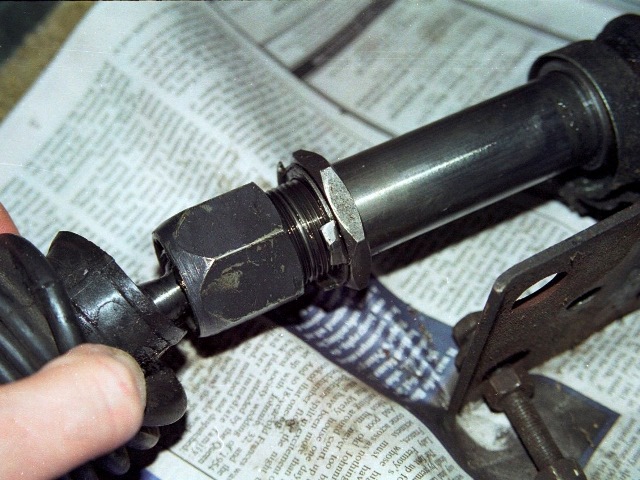
Therefore the aim was only to re-grease the internals and re-paint the housing. The pinion end of the housing is fixed to the picture frame via an attachment plate and beneath that is a pinion retaining plate. The profile of the pinion is such that there is a middle section that has a smaller diameter than the outer ends.

The retaining plate has a machined slot in the shape of two overlapping circles matching the two pinion diameters. The larger of which is off-centre. The plate slides over the end of the pinion through the larger hole before it can being centralised once it has reached the narrow section. Therefore the three studs must be removed to enable the retaining plate to be withdrawn.

Pinion attachment plate Pinion retaining plate Removal of sprung plunger

A sprung plunger is used to remove the free play in the rack and is held in place by a cover and circlip. Similar sprung plungers are used to provide sufficient resistance in the movement of the tie rod ball joints in their retaining housings.

Tie rod ball housing Rack, pinion and housing

Unfortunately there was a considerable break between the dismantling phase and finally getting round to rebuilding it. Sufficient time for the rack to be misplaced while in storage and numerous searches failed to locate it.

With time running out, I had little option but to bite the bullet and purchase a new rack and pinion from Kiley-Clinton engineering. I knew I’d probably find the original rack shortly afterwards but the knock on affect of replacement would also be a full rebuild of the steering unit.

The profile of the pinion changed during the production of the Series 2 cars and with it the size of the larger of the pinion bearings. Naturally I had the later type and the replacement rack and pinions are only available in the earlier size. So I would need to replace the bearings to suit and, in a case of shipwright’s disease, it made sense to replace the brass bush pressed into the housing at the same time.

The removal of the brass bush proved rather tricky without access to proper presses. As it’s fairly thin walled it’s difficult to get a drift on to it and I had to resort to a cold chisel to get it out.
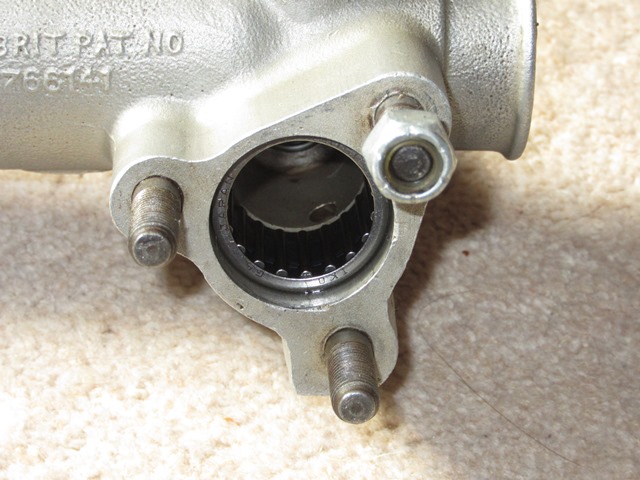
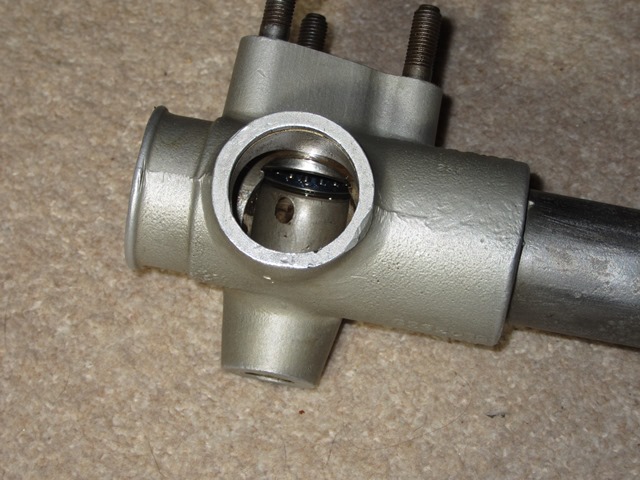
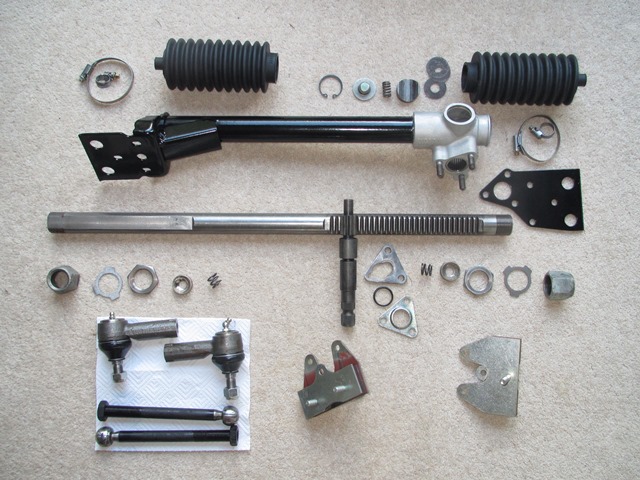
I thought it best to get the local garage to press in the new bush and bearings to avoid any further mishaps. How wrong could I be!! They had pressed the outer pinion bearing in as far as it would go until it had reached a shoulder in the alloy housing. This resulted in the bearing protruding into the main shaft and stopping the rack being inserted.

A bearing pressed too far!! Resulting in a protruding bearing

It would have to be re-done so I carefully ground down the bearing casing until it could be removed. With hindsight I should probably have sacrificed the smaller end bearing which would have given access for it to be drifted out.

The brass bushes are made slightly oversized and so it needs to be reamed in order to insert the rack, which should be a snug fit. I had to rely on the local machine shop as I didn’t want to purchase an adjustable reamer for a one off job.

Just as all the components were ready to be rebuilt, I was searching for the gearbox breather when I stumbled upon the long lost original rack. Aaaargh!
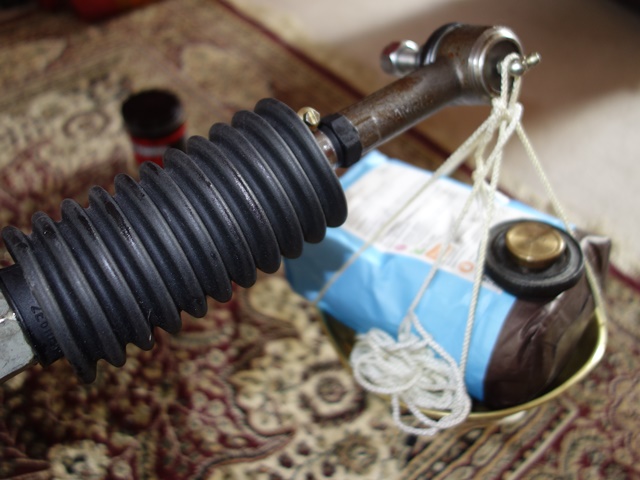
Copious amounts of grease was applied during the rebuild. The only two points of interest were the need to shim the sprung plunger to give the correct end float of 0.15-0.25mm in the rack and obtaining the correct resistance in the tie rod ball joints.

The service manual recommends using a spring balance to check that the tie rod only starts to move under a load of 7lbs. It was a rather fiddly process as a large change in clamping force is achieved by a very small rotation of the ball housing. A process not helped by my Heath-Robinson replacement for the spring balance – kitchen scales weights and a bag of flour!

Testing the fuel pump

 Fuel Pump, Fuel System  Comments Off on Testing the fuel pump
Jul 092013
 

It has been a long time since the fuel pump had been rebuilt, converting it from mechanical to electronic actuation in the process. Burlen Fuels offer an electronic conversion kit to overcome the known issues with point corrosion with the mechanical set up. While it would have been cheaper to buy a new pump, by reconditioning/converting it, I would gain a much better understanding of how it worked which might prove useful if there are issues in the future.

The electronic set-up had already been tuned to its maximum pumping speed, by rotating a Hall Effect fork. I just needed to check the flow rate was close to the designed 2.4 pints per minute by bench testing it with some paraffin before putting it on the car.

The pump raced when it wasn’t under load. So far, so good! However when the inlet pipe was placed in the bucket of paraffin it didn’t quite go as planned. It stopped immediately! I tried retuning the electric circuitry by repositioning the Hall Effect fork through its full arc of travel but it still refused to pump. It was a bit gutting having spent all that time and effort.

The technical department at Burlen Fuels thought it might be due to reverse pressure which would naturally slow the pump down. Although I wasn’t convinced as the outlet was simply pumping back into the supply bucket. I was running out of options and was starting to regret not buying a new pump!

I refitted the magnet attached to the end of the diaphragm spindle in the hope that this might be limiting its travel and therefore the strength of the pump. Eureka – the pump continued under load but at a much reduced rate, which would be expected.

The proof would be in the achieved flow rate which, over three tests, averaged out at 1.6 litres or 2.8 pints. Phew!
I was now happy that the pump was in working order and could be refitted to the car.

EDIS Megajolt electronic ignition

 EDIS Megajolt, Rolling Chassis  Comments Off on EDIS Megajolt electronic ignition
Jul 082013
 

The engine had been rebuilt by VSE with a replacement 123 Electronic distributor rather than refurbishing the original Lucas unit. However a chap, Ray Livingston, in the States had produced a kit for the 6 cylinder E-Types based on the Ford Electronic Distributorless Ignition System (EDIS), controlled by a programmable Megajolt Lite ignition unit.

A number of forum members had already installed his kit and reported on the quality of the machined components and improved running. In the interests of reliability, I decided to do likewise and order a kit as Ray was planning his final batch of kits and only a limited number remained. By chance another owner in Norway was looking for a 123 distributor so I managed to sell him my unused one.

The system has four main components: a trigger wheel & sensor, EDIS module, coil pack and the Megajolt controller. The trigger wheel is mounted to the front of the crank and has a series of teeth around its circumference, which pass close to the sensor. One tooth is missing to provide a reference point for the engine’s TDC. From what I can tell the sensor must use a Hall Effect device acting as a proximity detector to register each tooth as it passes the sensor head.

The signal from the sensor is interpreted by the Megajolt unit’s software to control the EDIS module and the coil pack. The coil pack has a HT output for each cylinder, however the spark for each cylinder is controlled electronically rather than mechanically, as in the original Lucas distributor. The Megajolt unit also has a vacuum input to enable the vacuum advancing of the ignition.

At this stage the key components will be installed but the final wiring and set-up will have to wait until the kit’s wiring loom is in place once the engine has been installed.

The instructions for the EDIS kit suggested using the LHD steering column bolt holes. The hole looked too small however it was due to a plastic cup being pressed into the hole and then painted overThe Megajolt control unit is fitted to the bulkhead just behind the glove box. Rather fortuitously the mounting points for the steering column is exactly the correct spacing for the Megajolt unit, so the unused LHD column bolt holes are used to secure the unit to the bulkhead.

However I couldn’t screw in the lower mounting post as the bolt hole was smaller, unthreaded and blanked off. After much head scratching I decided to re-tap the bolt hole to the correct diameter. This wasn’t successful either and then it became clear what was wrong – the hole has been plugged with a plastic insert which just had to be pushed out!

The Megajolt unit can be connected to a PC’s USB port to programme the desired ignition timing curves although it is pre-programmed with standard curves out of the box. The connections won’t be accessible once the dash is in place, so I’m planning to add a surface mounted USB port to the rear of the glovebox.

The kit provides a replacement blanking plate for covering the unused LHD accelerator opening. The plate contains holes for the unit’s wiring harness and vacuum pipe. However I wanted to keep the installation a low key as possible and took a leaf out of the book of a member of the E-Type forum, and route these within the bulkhead and exit via the hole for the speedometer cable. All that would be required was a larger grommet.

The Megajolt controller is mounted to the LH side of the bulkhead using the LHD steering column bolt holes

The routing of the wiring harness and vacuum pip was routed within the bulkhead void and enters the engine bay via the hole for the speedometer drive

The wiring harness travels along the LH engine frame close to the EDIS module located next to the vacuum Reservac tank. The remaining components, the coil pack and trigger wheel & sensor, are mounted directly to the engine.

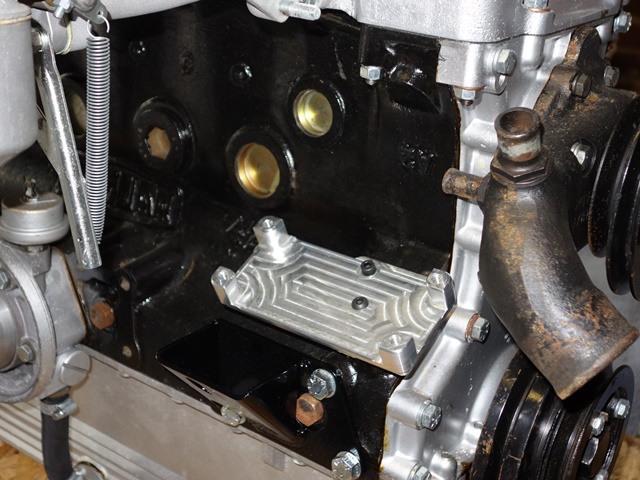
The coil pack is bolted to an aluminium bracket mounted directly into the hole for the standard distributor and so should be a reasonably unobtrusive modification.

The EDIS module is attached to the LHS engine frame near the vacuum reservoir

The coil pack mounting bracket locates in the vacated distributor drive hole

The coil pack trial fitted to the mounting bracket as it will have to be removed when the engine is installed

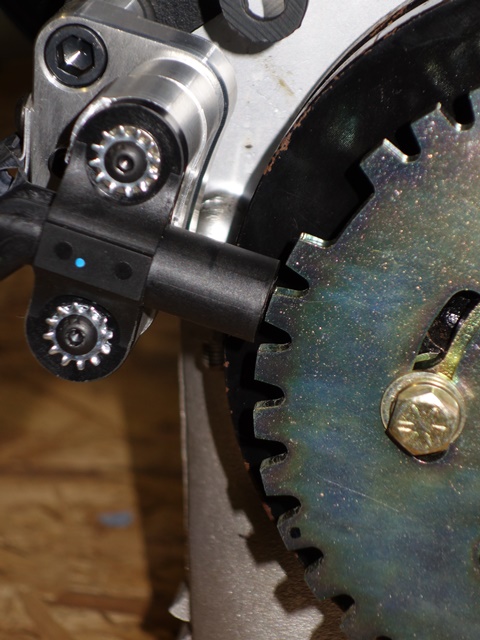
The fitting of the crank sensor and trigger wheel was the only tricky part of the installation simply because the positioning of the trigger wheel needs to be aligned to TDC. The sensor bracket is mounted using two of the timing cover bolt holes and is adjustable so the optimum gap can be set between the sensor and the trigger wheel.

However the sensor has to be removed to slacken the bolt to adjust the gap. This led to a rather iterative approach to setting it up but nothing to difficult.

The sensor bracket is mounted using two of the bolt holes on the timing cover. The end of the bracket is adjustable, allowing movement to vary the air gap to the trigger wheel

The adjusting bolt is hidden once the sensor is fitted so it was an iterative process to get the gap correct

A large torque wrench enabled the engine to be turned over more smoothly to accurately get TDC

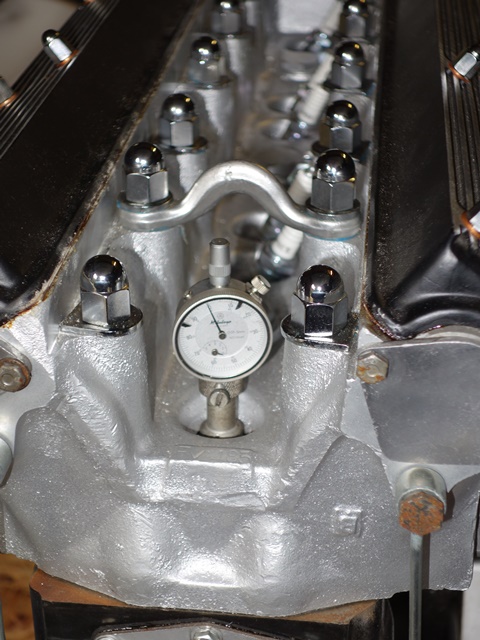
The engine had just been rebuilt by VSE so the positioning of the TDC mark on the damper should be spot on but I decided to check anyway. Another eBay purchase was a dial indicator with a spark plug adaptor to accurately measure the engine’s TDC before the trigger wheel was fitted. Great in theory, however the adaptor’s plunger was too short to reach the piston head even at TDC.

Hmmm …. a high-tech replacement plunger was knocked up out of a short length of 3/16″ brake piping flared at one end and some masking tape to bring out to the bore of the adaptor. I found the easiest method of rotating by hand was to remove all the spark plugs and use a large torque wrench on the crank nut.

A dial indicator was used to obtain TDC and to check the TDC marking on the damper were correct

Once the trigger wheel was fitted, the air gap had to be checked by turning the engine over by hand to ensure it would not make contact with the sensor when the engine is running

After a little bit of adjustment, the trigger wheel and sensor had a sufficiently small air gap without making contact

Once I was happy that TDC had been achieved, the trigger wheel was temporarily attached to enable the re-checking the sensor gap for a full rotation. The last step was to check TDC again before the applying Loctite to the trigger wheel bolts one by one.

Fingers crossed everything is correct and the engine will fire first time!

Update: the engine fired up on the first turn of the key!!

Reuniting the engine and gearbox

 Rolling Chassis, Transmission  Comments Off on Reuniting the engine and gearbox
Jul 082013
 

My aim is to spend a long weekend in August (with the wishful thinking that it’ll be sunny!) to transform it from a bodyshell into a rolling chassis; installing the fuel system, rear suspension, engine/gearbox & ancillaries, front suspension and steering all in one hit. So I’ve got my work cut out to get everything ready in time.

The bonnet and front sub-frame need to be removed in order to fit the tiny radiator support brackets so I’m also going to remove the picture frame at the same time. It should then be possible to roll the engine and gearbox unit into place through the gap and avoid the hassles of installing the engine either from above or below.

The gap between the lobes at the lower front edge of the engine frames is only 22cm. However, if the water pump is removed, the engine is slightly narrower than this just below the height of the inlet manifold. The engine has been rebuilt by VSE with a new clutch fitted so I just had to attach the gearbox and bellhousing. However the reuniting of the transmission unit would feel like a major milestone had been reached!

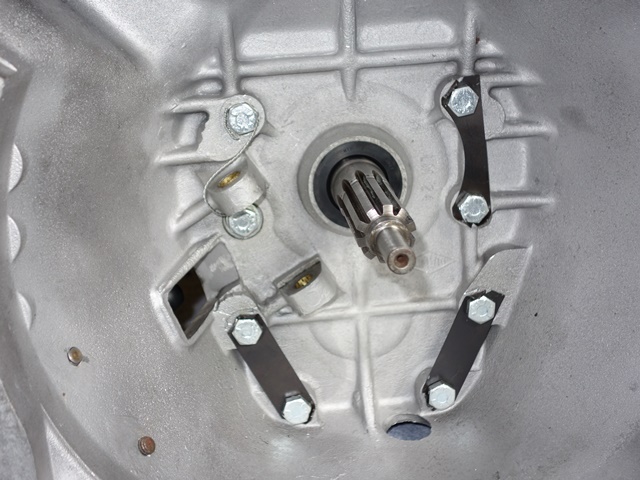
The bellhousing had already been ultrasonically cleaned and just needed the rear oil seal inserted before being bolted to the gearbox. Three lock tabs are used to prevent six of the bolts from working loose. The remaining two bolts, next to the clutch fork, use safety wire instead.

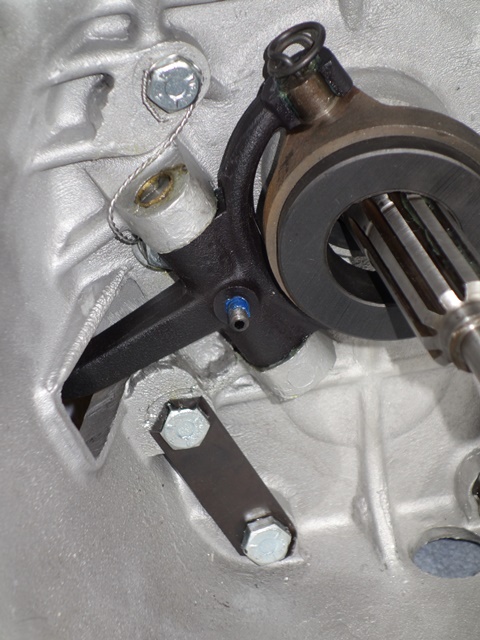
I’d never needed to use locking wire on previous vehicles so needed to purchase a pair of safety wire pliers. Eventually I managed to obtain an old pair on eBay and some 0.81mm stainless wire.

The pliers were definitely a good investment, less so was the wire that I purchased. It snapped as soon as a few twists were applied. I hadn’t purchased annealed wire – dooh! After purchasing the correct type, it was a lot more successful! The main point is to make sure the wire passing round the outside of the bolt head puts tension on the bolt in a clockwise direction.

The fitting of the clutch release bearing and operating fork is all very straight forward. The fork can be inserted with the bearing attached which makes fitting the securing spring clips much easier. The clips are held in place by the curved end sitting in a slight dimple in the fork arm.

The push-fit spring clips secure the clutch release bearing to the operating fork. The curved spring end sits in a dimple in the fork

The pivot pin was lightly greased and aligned with the grub screw hole in the fork before inserting

A little Loctite was used on the grub screw which locks the pivot pin in position. A lock nut is then fitted on the grub screw.

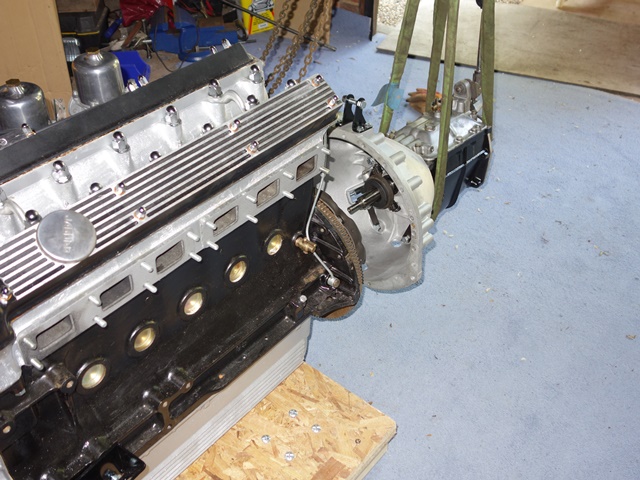
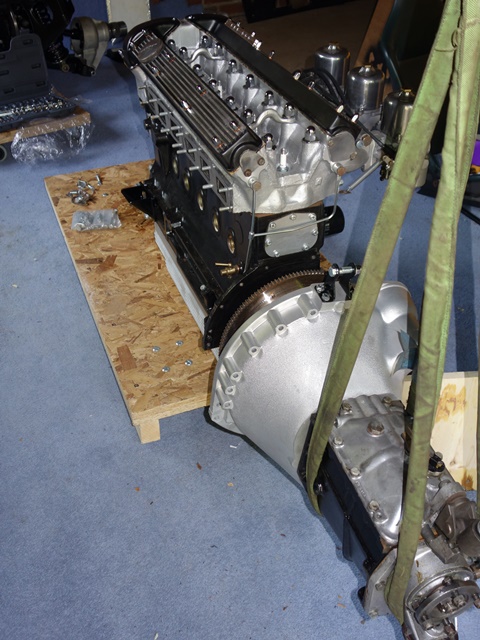
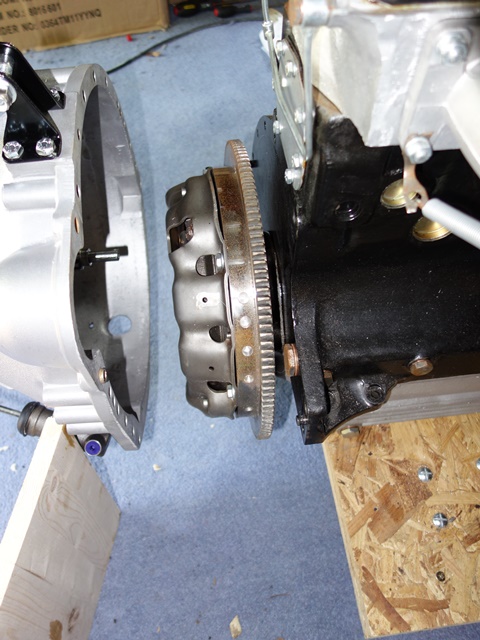
The engine was already sitting on the DIY trolley which will be used to roll it into position once the front frames are removed. Hoisting the gearbox to the same level meant it was simply a matter of rotating it to align the drive splines. Once the splines were engaged the gearbox could be rotated back again to align the bolt holes.

Supporting the gearbox with the engine hoist made the job much easier

It was also very helpful to have the engine mobile to align the two units

The weight of the gearbox was used to help push the gearbox onto the clutch splines

The two bellhousing support brackets needed to be installed before the full weight of the gearbox could be released. Finally the flywheel cover plate was bolted on to finish the job.

I did make the mistake of fitting the clutch slave cylinder when fitting the bellhousing to the gearbox but had to remove it to fit the lower bolt for the support bracket. I’ll make the final adjustments of the clutch just before the engine is installed.

One thing I’m not sure about at this stage is the orientation of the four vertical bolts for the support brackets. One of the bolts is longer than the others and so I guess must be used to secure a bracket of some description. Another question for the E-type forum ….

Fitment of the bellhousing support bracket is needed before it can take the full weight of the gearbox

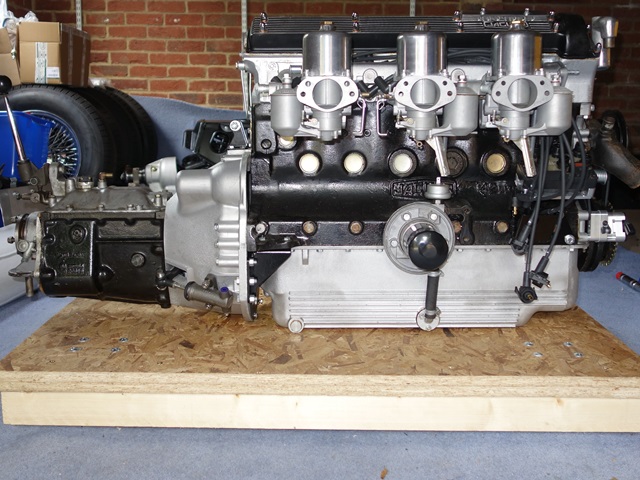
A major milestone reached - a completed transmission unit ready to fit. I hope it starts!!

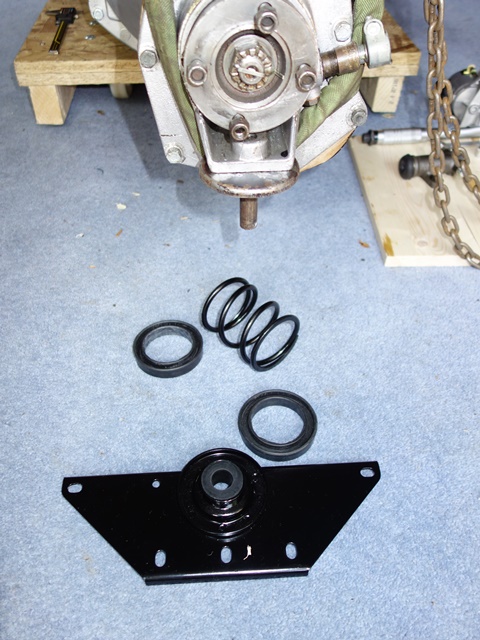
The rear of the gearbox has a sprung fitting to absorb vertical movement

The gearbox is supported at the rear by a large spring between a mounting bracket and the gearbox. The spring damps the movement of the gearbox but allows for a degree of vertical travel. The spring ends sit in rubber mouldings. The mounting bracket also contains a rubber bump stop to limit the gearbox travel.